
Machined Titanium Parts for Implants, Flight and Hard Use
Shenzhen XS Precision machines titanium the way it has to be machined: slow enough at the cutting edge to keep the tool alive, rigid enough to hold a wall that wants to spring away, and with the chip, the coolant and the fire risk managed as part of the process rather than as an afterthought. Grade 2, Grade 5 and Grade 23 ELI are the three we hold stock against.
Most titanium enquiries are not hard because of the geometry. They are hard because the alloy stores heat at the tool tip, moves away from the cutter, and work-hardens if a pass is allowed to rub. That is a process problem, and it is solved before the first cut.
GRADES WE HOLD
Grade 2
345 MPa
Grade 5
950 MPa
Grade 23 ELI
ASTM F136
CP titanium, Ti-6Al-4V and the implant-grade ELI variant, each with mill certs and lot traceability from bar to finished part.
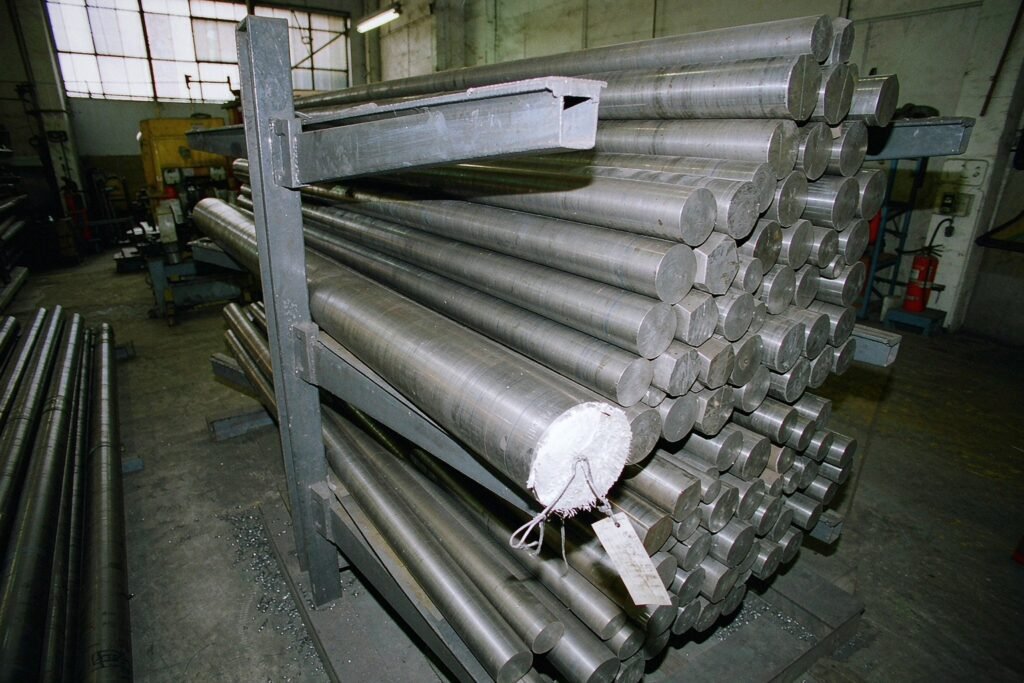
Titanium round and hex bar stock, cut and tagged before it reaches a machine
Titanium rewards a controlled process and punishes an improvised one
Three material properties explain nearly every problem a shop has with titanium, and none of them can be argued away with a better machine. Heat does not leave with the chip, the part deflects under a normal cutting force, and a pass that rubs instead of cuts leaves a harder surface behind it.
Ti-6Al-4V conducts about 6.7 W/(m·K), against roughly 50 for carbon steel and 200 for aluminium. The energy has nowhere to go, so the tool tip runs far hotter than it would in steel at the same speed. That is why titanium is cut at 40–80 m/min while aluminium runs several times faster.
Elastic modulus is about 114 GPa, close to half that of steel. A thin wall deflects under the cut, springs back, and finishes undersize; long tools chatter. Fixturing and tool reach matter more here than on any other metal we machine.
Titanium work-hardens quickly. A worn insert that skims instead of shearing leaves a hardened skin, so the following pass cuts harder material, generates more heat, and wear accelerates from there.
Titanium reacts with tool material at temperature, welding to the rake face and pulling material out of the edge. Coating choice is not cosmetic: fine-grain carbide with a PVD AlTiN or TiAlN coating, sharp and positive-rake.
Fine, dry titanium chips burn hard once they are hot, and water or a standard CO2 extinguisher feeds the fire — Class D dry powder or dry sand is the correct answer. We run flooded with high-pressure coolant on production work, keep titanium chips in dedicated carts, and never let them share a bin with steel swarf. On medical and aerospace jobs that separation is not housekeeping, it is a contamination control.
Grade 2, Grade 5 and Grade 23 ELI cover almost every job
Choosing the grade is a cost decision as much as a technical one. Over-specifying is the most common way to waste money on titanium: Grade 5 where Grade 2 would do roughly doubles the material bill, and Grade 23 where Grade 5 is acceptable adds another 15–40% for toughness the part may never need.
Chemical and marine hardware, heat exchanger parts, anode hangers, weldments. Density 4.51 g/cm³, yield around 275 MPa, and raw stock some 30–50% cheaper than Grade 5.
Aerospace brackets and fittings, fasteners, motorsport links and valves, surgical instruments. 4.43 g/cm³ with roughly 950 MPa annealed.
Grade 7 adds palladium for reducing acids and crevice conditions; Grade 12 (Ti-0.3Mo-0.8Ni) covers hot chloride brine at lower cost. Both are bought on the corrosion case, never on strength.
High strength, Corrosion resistance and Lightweight
The three advantages buy tend to be quoted as slogans. Each one has a number attached, and each one has a condition where it stops being true.
Ti-6Al-4V annealed reaches about 950 MPa ultimate with 880 MPa yield, at a density of 4.43 g/cm³ — roughly 56% of steel by weight. Solution treated and aged, the same alloy passes 1170 MPa.
The protection is a 2–6 nm titanium dioxide film that re-forms in seconds whenever oxygen or water is present. Seawater, wet chlorine and oxidising acids are close to a non-issue.
At 4.43 g/cm³ against 7.9 for steel, titanium takes out real mass where the load path allows it. Exhaust and structural hardware routinely come in more than 40% lighter than the stainless equivalent.
Read that axis honestly: titanium’s strength-to-weight ratio is close to high-strength aluminium alloy, not double it. What titanium actually buys is strength that survives temperature, a surface that does not need protecting, and fatigue performance in a corrosive environment. If the part runs cold, dry and stiff, aluminium is usually the better engineering answer and Shenzhen XS Precision will say so at quote stage.
Medical implants, Aerospace components, High-performance engineering parts
Three application families take almost all the titanium we cut, and each one arrives with its own paperwork, surface rules and failure mode.
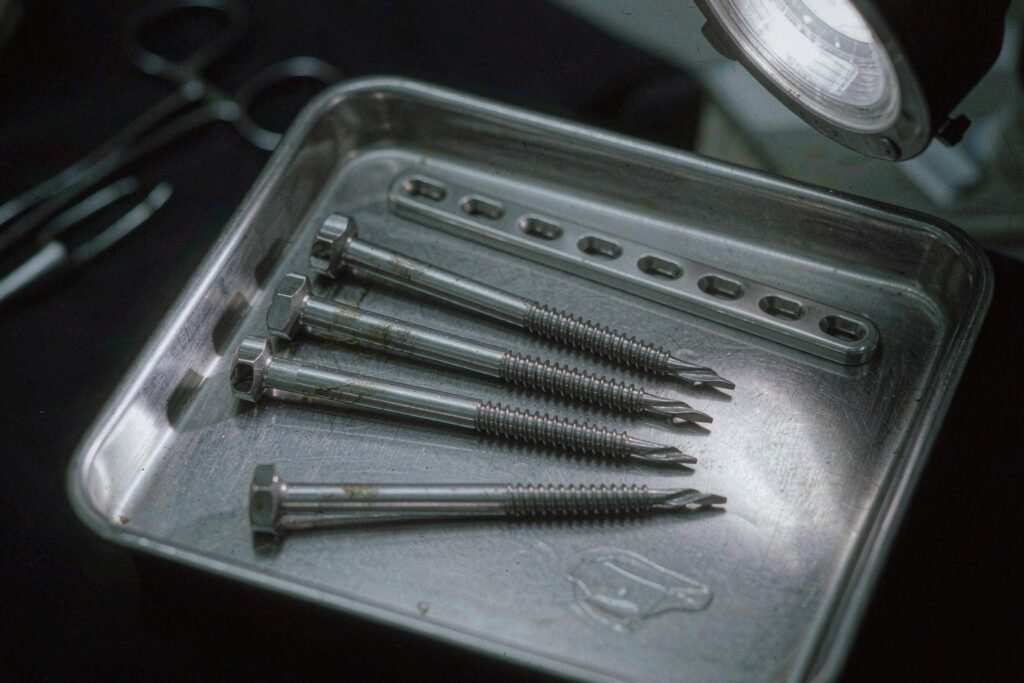
Bone screws and plate, machined from implant-grade titanium bar
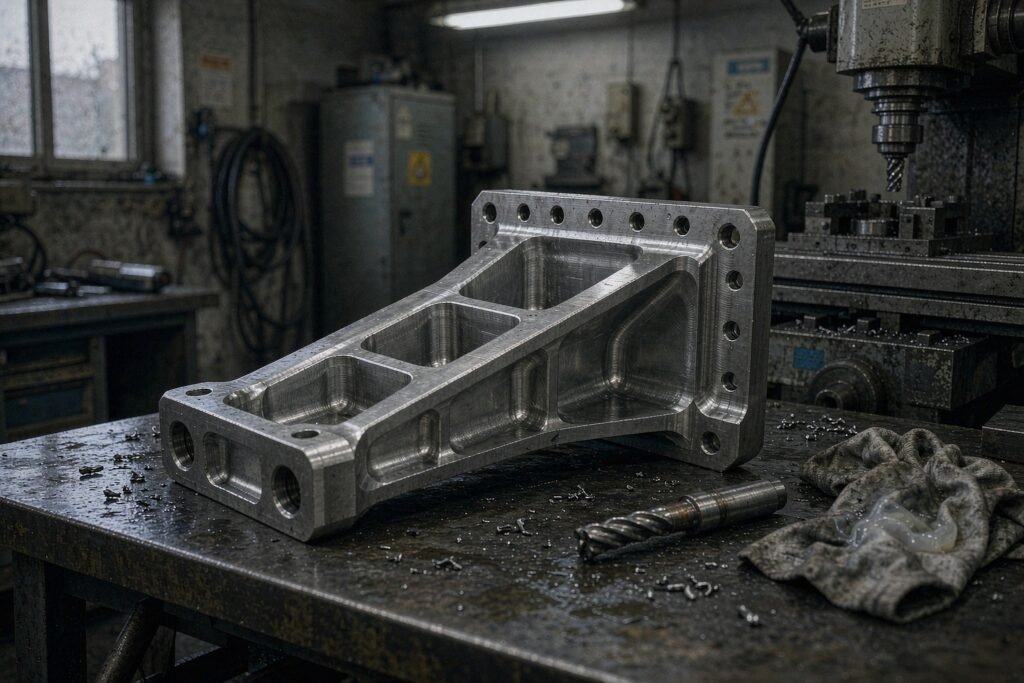
Milled aerospace bracket with lightening pockets and a flange

A titanium flange for seawater service and chemical duty
Bone screws, trauma plates, spinal components and dental abutments. Grade 23 ELI to ASTM F136, or CP titanium to ASTM F67 where the design calls for it.
Brackets, fittings, clevises and fasteners, usually from AMS 4928 bar or AMS 4911 plate. Deep pockets and thin ribs demand a symmetric roughing strategy.
Motorsport links, valves and exhaust hardware, marine and chemical process parts, ROV frames, downhole components. Often Grade 2 where corrosion is the whole argument.
Speeds, coolant and chip control decide the tool life
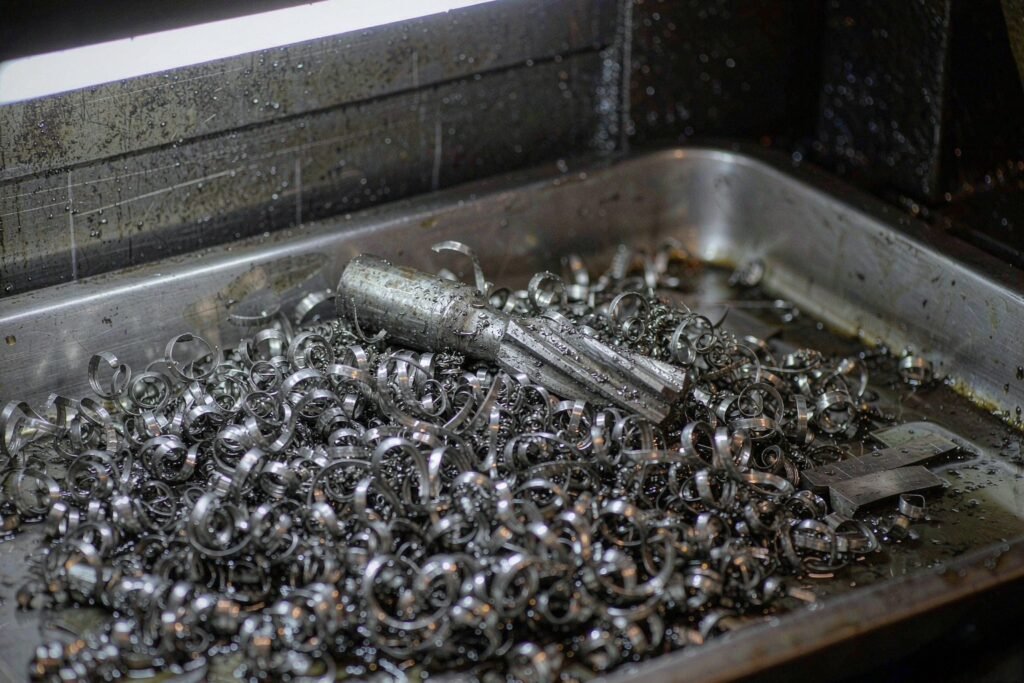
Titanium chips after a roughing pass, with the end mill used
These are working numbers for Ti-6Al-4V with carbide on a rigid machine, not a datasheet ideal. Final values are set per part, per feature and per batch, and recorded so the next run starts from proven settings instead of a guess.
| OPERATION | SPEED | FEED / NOTES |
|---|---|---|
| Milling, carbide, climb | 40–80 m/min | 0.05–0.15 mm/tooth, radial light, axial deep |
| Turning, rough | 30–50 m/min | 0.15–0.30 mm/rev, 1.0–4.0 mm DOC |
| Turning, finish | 50–80 m/min | 0.08–0.15 mm/rev, one clean pass |
| Drilling | 10–25 m/min | Peck or through-tool coolant, never let it rub |
| Coolant | 70–100 bar | Water-soluble emulsion, no chlorinated additives |
| Finishing on medical work | PCD / DLC | DLC-coated cutters ran about 35% longer than TiAlN |
Two rules sit above the numbers. Cut deep enough to get under the layer the previous pass hardened, and never let the tool dwell on the surface. When chatter or built-up edge appears, drop cutting speed before dropping feed.
Chlorinated extreme-pressure additives are common in general-purpose cutting fluid and are a bad idea on titanium: chloride residues can drive stress-corrosion cracking on a stressed part, and the damage shows up in service rather than at goods-in. We run a chlorine-free emulsion and wash and dry parts promptly after any operation that uses liquid.
Anodising, passivation and what they do to a tolerance
Titanium anodising to AMS 2488 Type III is not a dye. The colour is thin-film interference: voltage sets the oxide thickness, thickness sets the colour, at roughly 1.6–2.5 nm per volt. That makes it a repeatable identification system for surgical sets — and a process that has to be controlled, because a 2 V drift is visible.
Dimensional impact: effectively none. A complete anodic film is 20–200 nm — against a ±0.01 mm band that is 10,000 nm. About half the film grows outward, so a 150 nm layer adds roughly 0.00015 mm to a diameter. There is nothing to pre-compensate on the drawing.
The control that matters is electrical. We use regulated DC supplies held to ±0.5 V for production and ±0.1 V where colour identifies a size or a variant, ramp at 1–5 V/s, hold electrolyte temperature within ±2 °C, and calibrate per alloy — CP titanium and Ti-6Al-4V do not produce the same colour at the same voltage.
Nitric or citric acid to AMS 2488 Method 1 / Method 2, or ASTM F86 for implants. Removes free iron picked up from steel tooling and fixtures, and restores the oxide. No measurable dimensional change.
To ASTM B912 / ISO 15730. Removes 2.5–7.5 µm, takes Ra from about 0.8 down to 0.05–0.1 µm, and removes the work-hardened layer left by machining — which is why it is specified on fatigue-critical surfaces rather than for looks.
A uniform matte finish for handling and for implant surfaces where a specific topography is wanted. Controlled media, documented, and done before any passivation step.
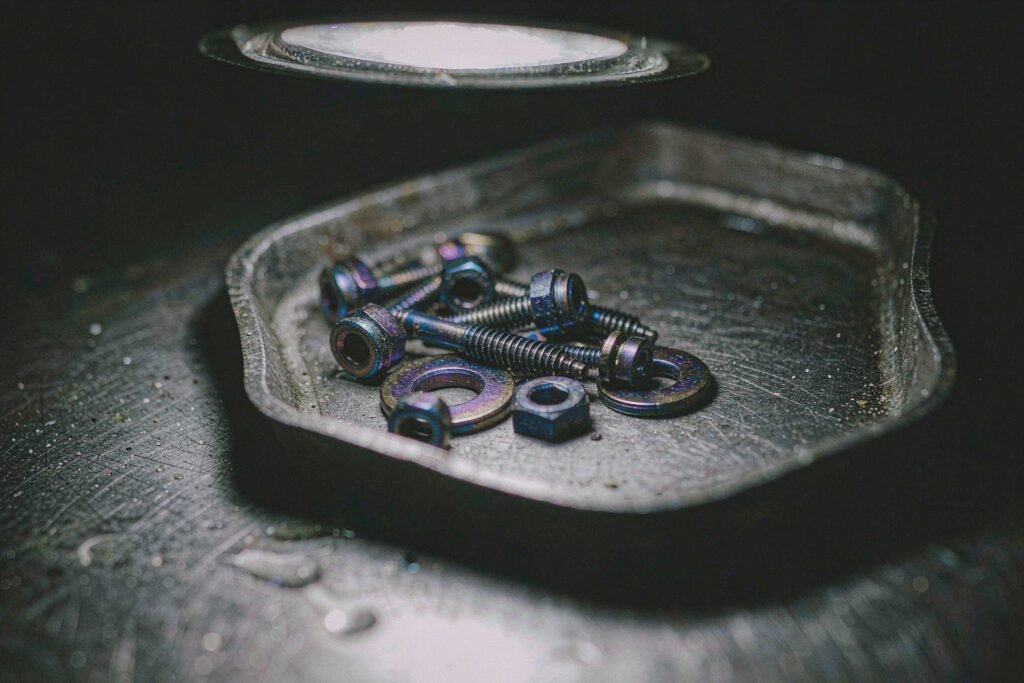
Anodize finishes on titanium: the colour is interference, not dye
The oxide film is the whole corrosion story
Titanium does not resist corrosion because it is noble. It resists corrosion because its surface is a ceramic that repairs itself. Understand where that film survives and you understand every titanium failure mode we have been asked to investigate.
The film needs oxygen to repair itself. In seawater, in body fluid, in oxidising acid, it is effectively permanent. In reducing acids such as hydrochloric or dilute sulphuric, and in tight oxygen-starved crevices, it does not recover — which is why grade selection is a chemistry question before it is a strength one.
Titanium sits at the noble end of the galvanic series. Bolt it directly to aluminium, magnesium or carbon steel in an electrolyte and it is the other metal that corrodes, faster than it would alone. Where a titanium part meets a dissimilar one we flag it at quote stage and insulate, coat or change the mating material — before the assembly is built, not after it is returned.
Above roughly 300 °C titanium starts to absorb oxygen and nitrogen from the air, forming a hard, brittle surface case. It is the reason high-temperature titanium work is vacuum or inert-gas processed, and the reason a heat tint on a finished part is sometimes more than cosmetic.
For implants, Shenzhen XS Precision works to the material standards the device file names — ASTM F136 for ELI bar and forgings, ASTM F67 for commercially pure, ISO 5832-3 — and keeps the melt lot identified from incoming bar through to the packed part.
Certificate, PMI and a dimensional report that you can audit
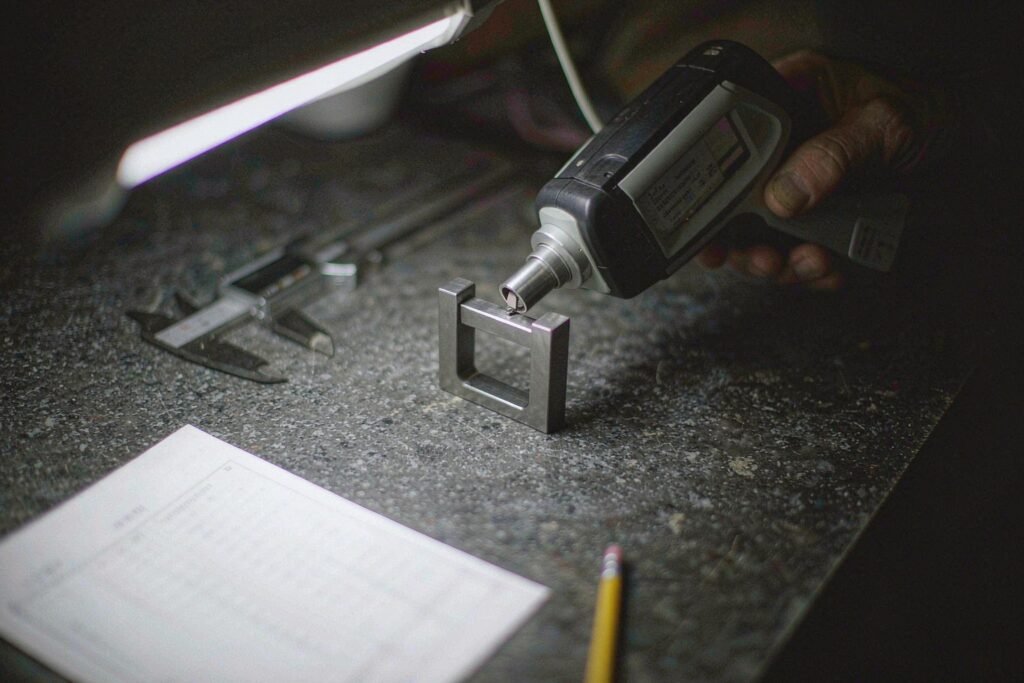
Alloy verification and dimensional inspection before any part ships
Every order that leaves Shenzhen XS Precision carries a certificate matched to the bar it was cut from, not to a stock line in a spreadsheet.
Three cases where titanium is the wrong answer
Titanium is expensive twice over: the bar costs more, and the hours on the machine cost several times more than steel. That is a good trade in the right place and a bad one in three recognisable situations.
At 114 GPa, titanium is not stiff. If the requirement is rigidity at room temperature in a dry environment, steel or a larger aluminium section will beat it on performance per dollar.
A straightforward bracket that never sees salt water and carries no weight penalty is better value in 316L or 17-4 PH. We will quote both when the drawing allows it.
Here titanium loses the film that makes it titanium. Grade 7 or Grade 12 may hold, and in some chemistries a nickel alloy is the only honest answer.
For a sense of scale: Grade 2 bar has been trading around US$11–14 per kilogram at mill, Grade 5 sits above that, and Grade 23 ELI adds another 15–40%. Machining time is usually several times steel. None of that is a reason to avoid titanium — it is a reason to specify the lowest grade that meets the case, and to design the part so it can be cut. Shenzhen XS Precision runs the titanium quote and the steel or nickel alternative from the same model, so the two numbers describe the same geometry.
Titanium questions, answered before you send the drawing
Should I specify Grade 5 or Grade 23 ELI?
Grade 5 for anything structural, aerospace, motorsport or instrumentation. Grade 23 ELI where the part is a permanent implant or is fracture-critical, because the lower oxygen limit gives better fracture toughness and slower fatigue crack growth. If the device file names ASTM F136, the choice is already made. Grade 23 costs more and buys nothing on a bracket.
What tolerance can you hold on titanium?
On stable setups with reasonable wall sections, around ±0.01 mm on features that carry the function, measured at a stated reference temperature of 20 °C. Thin walls and long tool reach widen that, and the honest answer depends on the geometry — we would rather quote a realistic band after seeing the STEP file than print a number that only holds on a test coupon.
Does anodising change the dimensions?
Not measurably. The oxide is 20–200 nm thick; a ±0.01 mm tolerance is 10,000 nm. About half the film grows outward, so a 150 nm layer adds roughly 0.00015 mm to a diameter. What anodising does change is appearance, and that needs a regulated supply: 2 V of drift at 40 V is a visible colour shift.
Will a titanium part cause galvanic corrosion next to aluminium?
Yes, if they are in electrical contact in an electrolyte — and it is the aluminium that suffers, because titanium is the noble one. Tell us what the part mates with and we will insulate, use a compatible coating or suggest a different mating material before the assembly is built.
What wall thickness and corner radii should I design to?
As generous as the design allows. Titanium punishes long-reach small tools more than any other metal we cut: keep internal corner radii at 3 mm or more, avoid deep narrow pockets, and leave 0.1–0.2 mm on bearing bores and datums for finish grinding. Those three changes cut more cost than any negotiation on rate.
Can you supply material certificates and full traceability?
Yes. Mill certificate to EN 10204 3.1 with the melt lot, PMI verification, a dimensional report at a stated temperature, heat treatment and surface treatment records, and a full lot package for implant and aerospace work.
Related capability and material pages on this site
Precision CNC machining
3-, 4- and 5-axis milling and turning, including the titanium speeds, feeds and coolant strategy described above.
High-precision components
Bores, datums and sealing faces held on titanium and other metals, with the inspection report to match.
Titanium against aluminium
The other side of the same decision — where aluminium wins on cost, stiffness and machinability.
Send the drawing. We will tell you if titanium is the right call.
A STEP file, the service environment, the mating materials and the faces that matter are enough to start. Shenzhen XS Precision returns a price, a lead time and a note on any feature that will be hard to hold in titanium — including the cases where another metal is the better engineering answer. NDA and drawing control are standard.
Mill cert to EN 10204 3.1 · PMI verified · dimensional report at a stated 20 °C · NDA before any file is shared