
Machined Engineering Plastic Parts for Insulation, Wear and Low Weight
We machine POM, PEEK, PTFE and PA (Nylon) to the same discipline as metal parts. Shenzhen XS Precision is a CNC machining supplier for engineering plastics applications: we hold bores, slots and sealing faces on polymers whose dimensions move four to six times faster than aluminium, and report every critical number at a stated temperature rather than at whatever the shop happened to be.
Plastic parts are rarely rejected because the material was wrong. They are rejected because the drawing asked for a metal tolerance, the stock was not stress-relieved, or the part was measured cold on a warm afternoon. Most of that is fixed before the first cut — in the machining strategy and the conditioning route, not in the drawing itself.

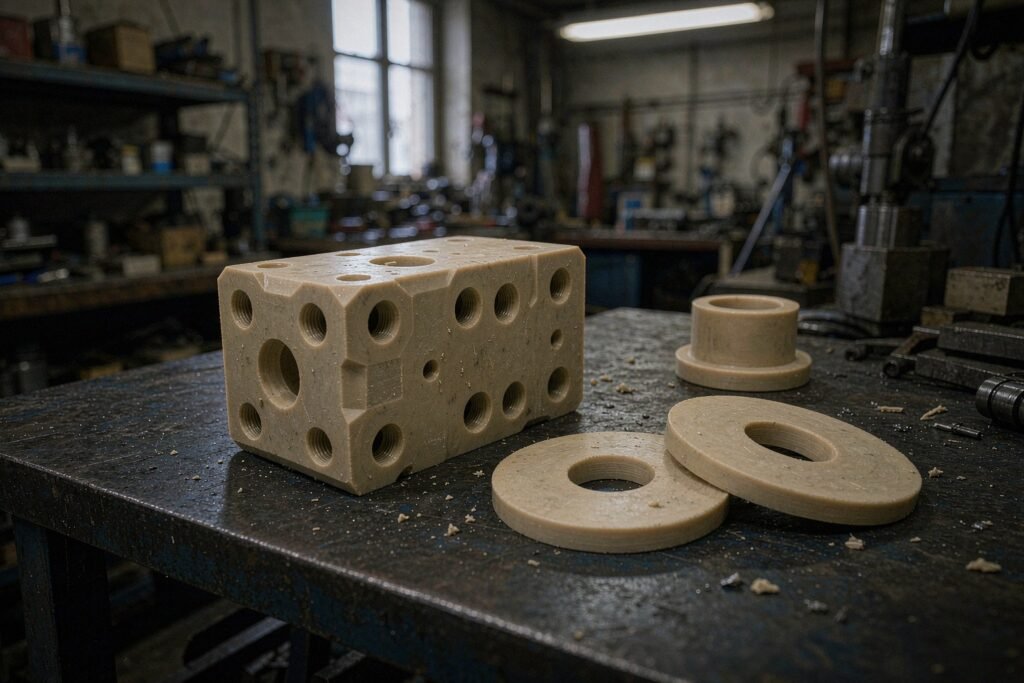
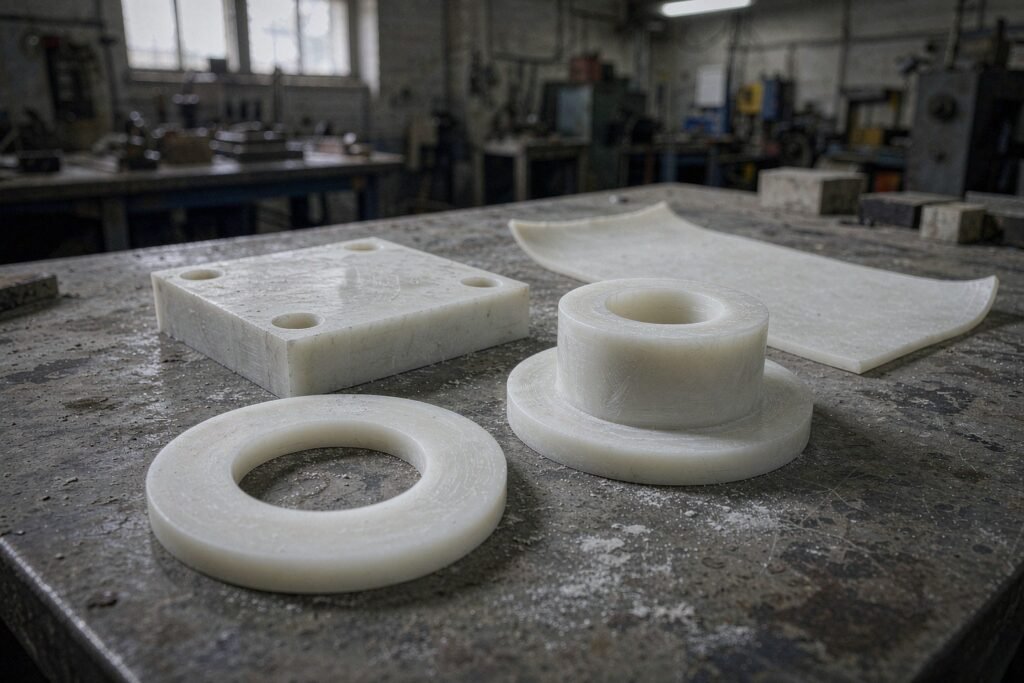
POM · PEEK · PTFE — MACHINED AT A STATED 20 °C
A plastic part is not a softer metal part
Aluminium expands at 23 µm per metre per kelvin. POM-C sits near 110, PEEK near 47, and PTFE near 130 — four to six times the metal figure. A 100 mm plastic feature crossing a 10 °C shop-to-shop difference moves 0.05 mm in POM and 0.13 mm in PTFE. Any tolerance written on the drawing has to be read together with the temperature it was measured at.
Two polymers go further. PTFE changes crystal structure at about 19 °C and again near 30 °C, and the specific volume can rise almost 1.8% across that range. PA absorbs moisture: around 35–65% relative humidity it settles near 1.5–2% by weight, and a PA6 test piece can grow about 0.5–0.6% in length as it takes water up.
Because Shenzhen XS Precision machines both metals and polymers, the comparison is made in one place. Polymer jobs are quoted with the conditioning route already in them: stock is stress-relieved, roughing and finishing are separated so the material is not released into the finish cut, and critical dimensions are taken after the part has settled at a stated reference temperature.
Where a drawing carries a tolerance that the material cannot hold across a normal workshop day, we say so at quote stage — and say which dimension will move, by roughly how much, and what the inspection report will therefore record.
Engineering Plastics: what POM, PEEK, PTFE and PA are each actually for
Four materials cover almost every plastic enquiry that reaches us. The notes below are the selection logic we use, not a datasheet — they are written around the failure each material is prone to.
Lightweight, low friction, low moisture uptake, machines predictably and holds a fit that lasts. Gears, bushings, valve seats, spacers and sliding blocks all live here, and it is the reference every other choice has to beat. The failure to watch is heat at the cut: POM melts and smears rather than cutting cleanly, so sharp tooling and air blast matter more than spindle speed. It is also the wrong material near strong acids or live steam above about 50 °C, where it hydrolyses.
Continuous service around 250 °C, excellent mechanical strength, good insulation properties at temperature, low creep and near-universal chemical resistance apart from concentrated sulphuric and nitric acid and some halogenated solvents. It is the answer for semiconductor and medical tooling, high-temperature connectors and pump internals. Two practical notes: the crystallinity depends on how fast it is cooled, and flood coolant can shock it, so dry machining with air blast is the normal route; and it costs several times what POM does, so it is worth asking whether the temperature really is above 150 °C before specifying it.
PTFE resists almost every industrial medium and has the lowest friction coefficient of the four, which is why seals, gaskets, liners and sliding insulators use it. The trade is dimensional: the highest expansion of the four, a soft surface that cold-flows under sustained load, and the two phase transitions near 19 °C and 30 °C that shift volume more than ordinary thermal expansion does. We machine, condition and inspect PTFE parts at one agreed reference temperature and state it on the report.
Nylon is chemical resistant against oils, greases and alkalis, takes impact better than POM, runs quietly against steel and resists these same media in everyday service, which suits rollers, wear pads, guide shoes and sprockets. sprockets. The catch is water: unfilled PA6 can grow around 0.5–0.6% in length as it reaches equilibrium, and its electrical resistivity falls by two orders of magnitude once conditioned, which matters on an insulating part. Tolerances here are quoted against a stated condition — dry as machined, or moisture-conditioned — and never left open.

Nylon wear parts: the one that needs a moisture decision first
PA6 and PA66 rollers, wear pads and guide shoes are common work at Shenzhen XS Precision, and they are the parts where a drawing most often leaves out the one thing that decides whether the batch passes. Unfilled nylon grows roughly 0.5–0.6% in length as it reaches moisture equilibrium with the air, so a 60 mm pad can move around 0.3 mm after it has been in a humid plant for a week — more than any tolerance worth writing.
The fix is not a tighter tolerance. It is a stated condition: parts are either measured dry as machined or moisture-conditioned to an agreed level first, and the report records which. Glass-filled grades cut the movement by roughly a fifth, at the cost of tool wear and a more abrasive chip.
Lightweight, insulating, chemically resistant — by how much
Three properties decide the material on most polymer drawings, and price is not one of them. Lightweight is the easy one; Insulation properties and Chemical resistance are where the grade, the filler and the moisture state move the number, so each is quoted here as a range rather than a single value. The meters below are relative within the four materials Shenzhen XS Precision machines most often.
Weight is the easy one: a filled grade sits near 1.4 g/cm³ against 2.70 for aluminium, so a part in PA6-GF30 weighs roughly half what the same part weighs in 6061. For a moving axis that is the whole argument — less mass to accelerate, less inertia for the servo to manage.
The electrical column is where specifications most often go wrong. Almost every unfilled plastic is an insulator, but the numbers are not interchangeable: PTFE leads at around 10¹&sup8; Ω·cm, PEEK sits near 10¹⁶, POM near 10¹&sup5;, and dry PA6 about the same — until it takes up moisture and drops two decades. Tracking resistance runs the other way: POM, PTFE and PA can reach CTI 600, while PEEK is nearer 150, so a high-temperature material is not automatically the best insulator.
The last two rows are the ones that change how a part is made. Plastics remove heat badly, so a polymer part carries the cutting heat until it can get out — which is why flood coolant is usually replaced by compressed air, and why a part can measure correctly at the machine and be out of tolerance the next morning.
Two materials that need the process, not just a programme
PEEK: crystallinity and cooling rate
PEEK’s properties depend on how it cooled. A heavy flood of water-based coolant at the cut is exactly the wrong input, so PEEK runs dry with air blast and generous chip clearance. A machined PEEK manifold or insulating washer keeps its dimensions and its strength because the process was set for the material rather than for the spindle.
PTFE: the 19 °C and 30 °C transitions
Below about 19 °C PTFE sits in a different crystal structure than it does above it, and it changes again near 30 °C. Across that window the specific volume can rise almost 1.8%, which is far more than ordinary thermal expansion accounts for. Seals, gaskets and insulating parts are therefore machined, conditioned and inspected at one declared temperature — and the drawing says which one.
Where insulating parts, wear components and precision mechanical systems differ
Almost every plastic enquiry we take lands in one of three applications, and each one has a question that decides the material before anything else is discussed. Insulating parts, wear components and precision mechanical systems take different polymers for reasons that have nothing to do with price.
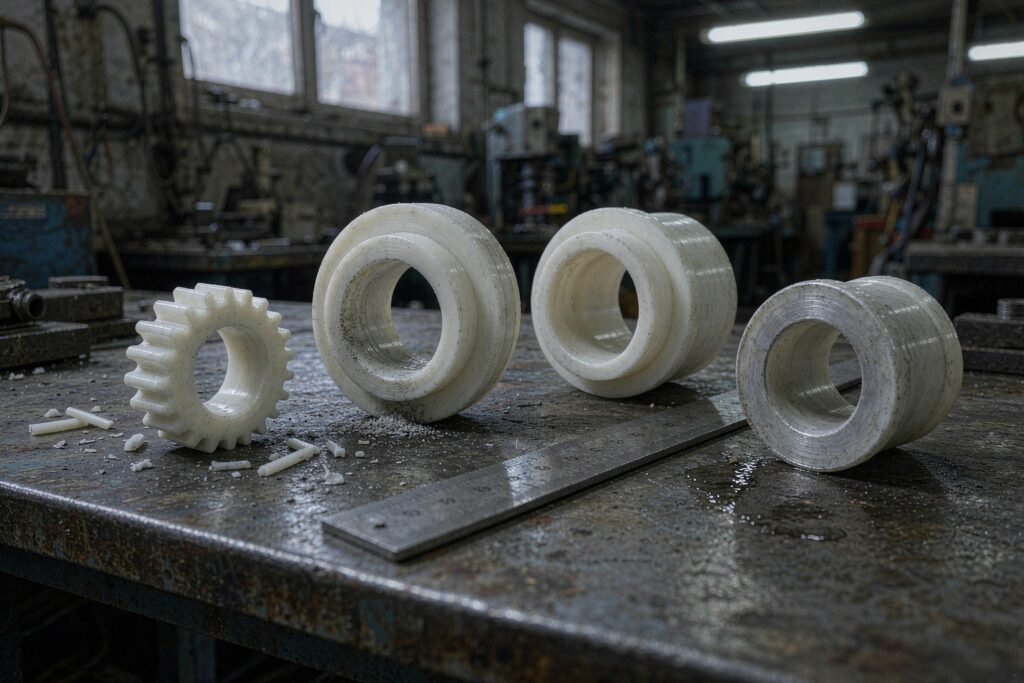
Machined POM components for insulating parts and wear components, cut from one billet and measured as a set.
What the four materials cost, and what they hold
Relative material cost, with POM as the reference. The gap between the ends of this ladder is the single most common source of unnecessary cost in a plastic part — the second table is what each material will actually hold.
Tolerances and conditioning
| PROPERTY | POM | PEEK | PTFE | PA6 |
|---|---|---|---|---|
| Routine tolerance | ±0.02 | ±0.02 | ±0.05 | ±0.05 |
| Best achievable | ±0.01 | ±0.01 | ±0.02 | ±0.02 |
| CTE µm/(m·K) | 110 | 47 | 130 | 80 |
| Water uptake % | 0.2 | 0.2 | <0.01 | 1.5 – 2.0 |
| Service temp. °C | ~100 | ~250 | ~260 | 80 – 120 |
| Machining coolant | Air blast | Air blast | Air blast | Air blast |
| Stress relief | 120 – 130 | 150 – 200 | Per geometry | Per geometry |
Tolerance figures are what we quote for machined features on stable wall sections, inspected at a stated 20 °C after the part has settled. Thinner walls, longer spans and unfilled PA move faster than these numbers.
The conditioning route
Extruded and compression-moulded stock carries internal stress. Hygroscopic grades are dried before cutting so the first operation does not start from a wet blank.
Roughing leaves 1.0–1.5 mm on every face. Removing most of the material in one pass is what makes a plastic part warp after the vice is released.
POM around 120–130 °C, PEEK 150–200 °C depending on grade, held by wall thickness and cooled slowly in the oven rather than on the bench.
Light finishing passes with sharp, polished-flute tooling and air blast. The finish cut removes the last allowance without loading the part with heat.
Critical dimensions are taken after the part has reached the reference temperature, and the report states that temperature and, for PA, whether the part was measured dry or moisture-conditioned.
Dry cutting, and inspection at one stated temperature

Air blast instead of flood coolant
Polymers carry cutting heat into the part instead of into the chip. Air blast and cold-air guns clear chips and cool the cut without the thermal shock that water-based coolant causes in PEEK, and without the moisture uptake it causes in PA. Long stringy chips and a clean edge are the sign the tool and the feed are right.

Measured after the part has settled
Every plastic production lot leaves Shenzhen XS Precision with a dimensional report covering the toleranced features, the reference temperature the measurements were taken at, and — for PA — the moisture condition. Where a fit depends on a sealing face or a bore, that face is measured on the part rather than inferred from the programme.
Answers before the drawing goes out
The questions below are the ones asked most often about machining Engineering Plastics at Shenzhen XS Precision — material choice, achievable tolerance, and what the inspection report will actually state.
How do I choose between POM, PEEK, PTFE and PA?
Start from the limiting condition rather than the material. Above roughly 150 °C or against aggressive chemistry, PEEK. Against almost any chemical at moderate temperature, or where the lowest friction matters, PTFE. Where the part slides, gears or has to hold a fit for years at moderate load, POM. Where impact toughness and quiet running matter more than the last hundredth, PA6 or PA66. Shenzhen XS Precision will say so at quote stage if the material you specified is more expensive than the job needs.
What tolerance can you hold on a machined plastic part?
On dimensionally stable polymers such as POM and PEEK with reasonable wall sections, we quote around ±0.02 mm routinely and ±0.01 mm on the features that carry the function, measured at a stated reference temperature. PTFE is quoted wider, typically ±0.05 mm routine and ±0.02 mm best, because of its expansion and cold flow. Unfilled PA depends on the moisture condition agreed for inspection.
How do you stop a plastic part warping after machining?
By removing the stress before it does. Stock is pre-dried where the grade is hygroscopic, roughed with 1.0–1.5 mm allowance, stress-relief annealed — around 120–130 °C for POM and 150–200 °C for PEEK, held by wall thickness and cooled slowly in the oven — then finished in light passes with air blast. It is the same logic as stress-relieving a welded steel frame before its mounting pad is milled.
Why do you machine plastics dry instead of with coolant?
Because polymers conduct heat badly, so the coolant is asked to do something it cannot. Water-based coolant thermally shocks PEEK and changes how it crystallises, and PA absorbs it. Compressed air or a cold-air gun clears the chips and cools the cutting zone without either problem. Where a specific feature needs liquid, we use it deliberately and wash and dry the part immediately.
Can a plastic part be specified as an insulator without more detail?
Better to state the voltage, the working temperature and the environment. Volume resistivity ranges from around 10¹&sup8; Ω·cm in PTFE to about 10¹² in moisture-conditioned PA, and comparative tracking index runs from roughly 150 V in PEEK to 600 V in POM and PTFE. A high-temperature material is not automatically the better insulator, and a hygroscopic one is not automatically the worse — it depends on the condition it will see.
What documentation ships with plastic parts?
A material certificate with the grade and batch, a dimensional report covering the toleranced features with the reference temperature stated, the moisture condition for PA parts, annealing records where a heat cycle was run, and photographs of the first article. Parts are bagged so finished faces arrive as they left the shop.
More detail on how these parts are made
Precision CNC machining
3-, 4- and 5-axis milling and turning for polymer and metal parts, with the tolerance and conditioning strategy explained.
High-precision components
Bored bores, sealing faces and dowel fits held on both plastics and metals, with the inspection report to match.
Engineering Plastics vs metals
The metal side of the same decision — where POM, PEEK, PTFE or PA stops being the right answer.
Send the drawing. We will tell you which material it needs.
A STEP file, the working temperature, the medium it contacts and the faces that matter are enough to start. Shenzhen XS Precision returns a price, a lead time and a note on any feature that will be hard to hold on a polymer — before the first part is cut. NDA and drawing control are standard, and nothing made for one customer is ever shown to another.
ISO 2768-mK where the drawing is silent · dimensional report at a stated reference temperature · annealing records on request