BRASS & COPPER · MATERIAL EXPERTISE

Machined Brass and Copper Parts for Electrical and Conductive Work

Shenzhen XS Precision machines brass and copper on the same multi-axis and Swiss-type equipment we run for stainless, with the tooling and the speeds these two metals actually need. Free-cutting brass comes off the machine almost without drama. Pure copper is a different job: soft, ductile and prone to built-up edge, so it is quoted and cut differently.
100
MACHINABILITY INDEX
FREE-CUTTING BRASS C36000
2.5–3.7% lead acts as an internal chip breaker and a lubricant. Every other copper alloy is rated against this number.
58 MS/m · 100% IACS390 W/(m·K)8.5 g/cm³
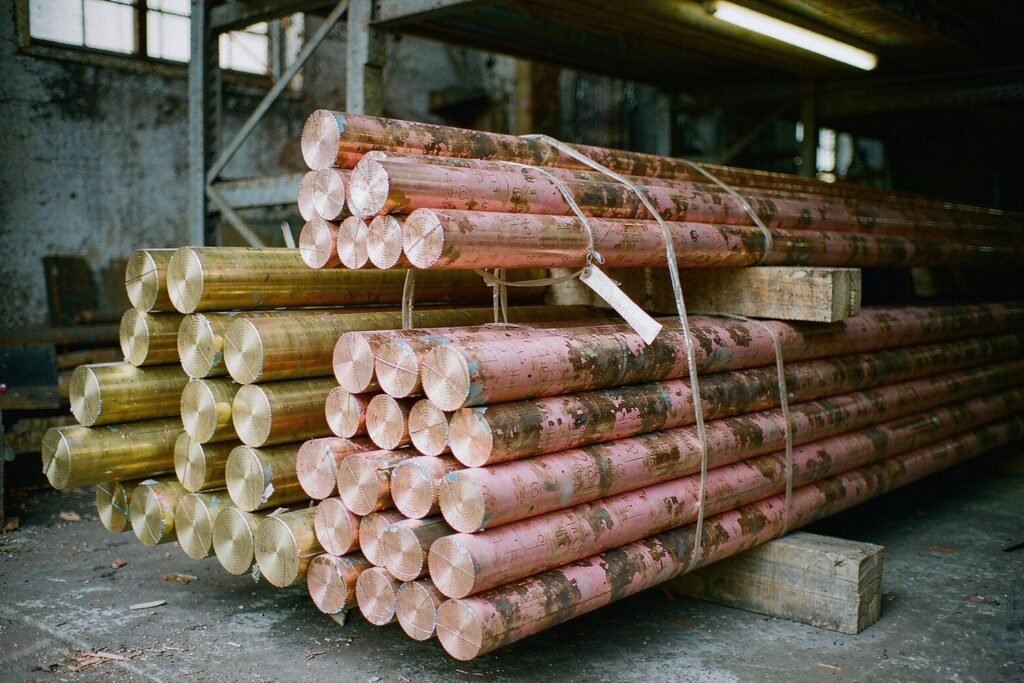
Bundles of brass and copper round bar in a warehouse rack, brass bars golden yellow and copper bars pink, with saw-cut ends, steel banding and wired paper tags
MATERIAL ON THE FLOOR

Brass and copper bar, sawn and tagged before it reaches a machine

Bar and hex stock to ASTM B16, B453, B187 and B371, with the heat number recorded against the bar the part was cut from. The two alloy families are stored and sawn separately so brass and copper never mix in the swarf bin.

WHY THE TWO METALS CUT DIFFERENTLY

Brass breaks its chips; copper wraps them around the tool

Brass and copper sit next to each other on the conductivity table and nothing else about them is similar on a lathe. Brass is a zinc alloy that shears cleanly. Copper is a soft, ductile metal that stretches before it separates. That one difference sets the tool geometry, the coolant policy and the price of the part.

FREE-CUTTING BRASS · C36000
Chips
Short commas that evacuate on their own. Nothing bird-nests around the tool or the bar feeder.
Built-up edge
None in practice. The lead phase keeps the rake face clean, so the finish repeats pass after pass.
Coolant
Dry or micro-mist is often enough; mist is only for heat at high spindle speeds.
Speed
200–300 m/min turning, 0.1–0.3 mm/rev, spindles up to 6000 rpm on small bar work.
VS
PURE COPPER · C11000 ETP
Chips
Long ribbons that tangle, wrap the tool and can pull the part out of the collet if the feed is wrong.
Built-up edge
The main cause of a torn, smeared finish. Cracked and re-welded copper sits on the cutting edge.
Coolant
A non-staining lubricant helps a lot. Sulfur- and chlorine-based additives attack copper and leave a dark stain.
Speed
80–150 m/min turning, light depths of cut, sharp edge, PCD inserts for volume work.
KEY ADVANTAGES, MEASURED

Excellent conductivity, Good machinability and Wear resistance, by the numbers

Three numbers decide most brass and copper drawings: how well the alloy carries current, how fast it can be cut, and how it behaves where two surfaces slide against each other.

100
% IACS
EXCELLENT CONDUCTIVITY
Copper C11000 ETP at 58 MS/m. Oxygen-free C10100 reaches 101%, and tellurium copper C14500 still holds about 93% while cutting like brass.
100
INDEX
GOOD MACHINABILITY
C36000 is the reference every other copper alloy is rated against. Lead-free C69300 sits at 75–85, and pure copper drops to about 20 without a free-cutting addition.
78
HRB
WEAR RESISTANCE
Drawn C36000 runs 55–80 HRB with a low friction coefficient against steel. In low-load sliding and light gear contact the brass wears instead of the shaft.
390
W/(m·K)
Pure copper — the reason a copper heat path works where an aluminium one cannot follow.
115
W/(m·K)
C36000 free-cutting brass, about four times 304 stainless steel.
167
W/(m·K)
6061-T6 aluminium, for comparison.
6.7
W/(m·K)
Ti-6Al-4V — heat stays in the cut instead of leaving with the chip.

The trade-off is always conductivity against strength. Cold work raises the strength of copper and pulls conductivity down by a few percent. Beryllium copper C17200 offers around 22% IACS with four to five times the strength of pure copper, and CuCrZr sits between the two. Shenzhen XS Precision will say when the extra alloy is doing real work and when it is being paid for with no benefit.

ALLOYS WE HOLD

Six alloys cover almost every brass and copper drawing

The copper-to-zinc ratio, and whether lead, tin, silicon or tellurium is present, decides machinability, strength, colour and whether the part is allowed near drinking water.

C36000 free-cutting brass
INDEX 100
Cu 61.5%
Zn 35.5%
The screw-machine standard: 2.5–3.7% lead, UTS 340–470 MPa depending on temper, HRB 55–80. Fittings, valve stems, terminal bodies and fasteners. Not permitted where lead is restricted.
C26000 cartridge brass
INDEX 30
Cu 70%
Zn 30%
The 70/30 brass with the best cold-forming behaviour and the familiar yellow colour. Chosen for drawn and spun parts and for hardware. Slow to machine, so it is rarely specified for turned work.
C46400 naval brass
INDEX 50
Cu 60%
Zn 39.2%
Around 0.8% tin is added to resist dezincification in seawater. Marine fasteners, shafts and fittings. Lead is normally held below 0.20%, which matters for potable-water work.
C69300 lead-free brass
INDEX 75–85
Cu 61%
Zn
Silicon-rich phases act as chip breakers instead of lead, holding lead under 0.09%. Sold as CW724R and ECO BRASS. Machining conditions must be optimised separately — copying a C36000 programme into it does not work.
C11000 electrolytic tough pitch copper
100% IACS
Cu 99.9%
The electrical default at 58 MS/m. It contains 0.02–0.04% oxygen, so it must not be brazed or welded in a hydrogen atmosphere — use oxygen-free C10200 or DHP C12200 for that.
C14500 tellurium copper
93% IACS
Cu 99.5%
Roughly 0.5% tellurium breaks the swarf into short chips while keeping about 93% IACS and a machinability rating near 85 — the alloy for machined conductive parts that pure copper makes expensive.

Specifying C36000 is the cheapest route to a machined brass part and the fastest route into a compliance problem: 3% lead sits inside the RoHS exemption for copper alloys, not outside the regulation. Where the part touches drinking water, is sold in California, or can reach a child, the drawing should name a lead-free grade and the order should carry the certificate.

HOW WE CUT IT

Speeds that use the material instead of fighting it
200-300
M/MIN · TURNING
C36000 with polished uncoated carbide. Coating adds little on brass.
0.1-0.3
MM/REV · FEED
Enough feed to keep the tool cutting instead of rubbing, which is what produces a bright finish on brass.
120-250
M/MIN · MILLING
Single-flute cutters clear brass chips instead of recutting them.
30-60
M/MIN · DRILLING
Peck cycles past four diameters deep; brass grabs a standard drill if the rake is too positive.
80-150
M/MIN · COPPER
C11000 turning with sharp positive geometry and light depths of cut.
<5
µm · TOOL RUNOUT
Collet runout below 5 µm is what makes a repeatable finish on small brass work.
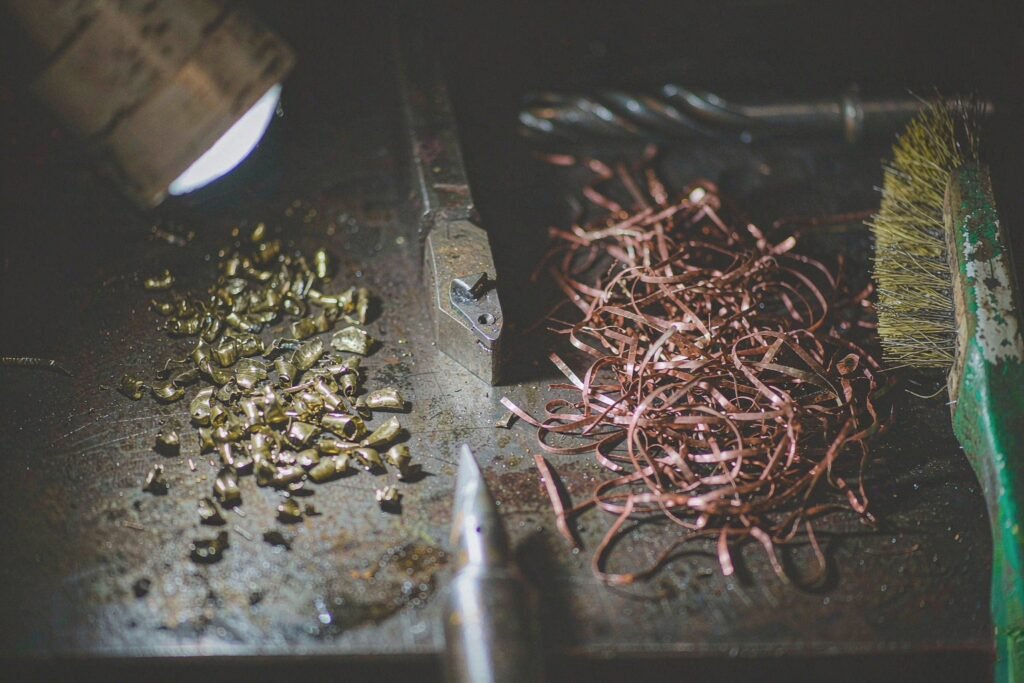
Short broken brass chips piled beside a tangle of long copper swarf ribbon, with a worn carbide turning tool and a chip brush on the machine table

Brass chips break into short commas while copper swarf comes off as a tangled ribbon

The chip is the cheapest quality indicator there is. Short sixes and nines out of brass mean the feed is right. A copper ribbon that wraps the tool means the feed is too light and the edge is rubbing — add feed rather than speed, and break the chip with a grooved insert.

Brass and copper swarf is clean, single-material and worth money. XS Precision keeps it in separate bins from steel and aluminium, because mixed swarf is sold as mixed swarf. On a family of parts that runs for years, that recovery is part of the price.

Brass wants a neutral edge
0° RAKE · FLAT TOP
A positive rake on brass digs in and the tool feeds itself into the part. A flat, neutral top face with a small nose radius holds the depth of cut and keeps the finish flat.
Copper wants a sharp positive edge
15–25° RAKE · POLISHED FACE
Copper needs the edge to slice rather than push. A high positive rake with a polished rake face stops copper welding to the tool, which is what a torn finish actually is.
WHERE THESE PARTS GO

Electrical components, Precision fittings and Conductive parts

Almost every drawing we quote falls into one of three families, and each one is judged on a different measurement: contact resistance, sealing and thread quality, or bulk conductivity.
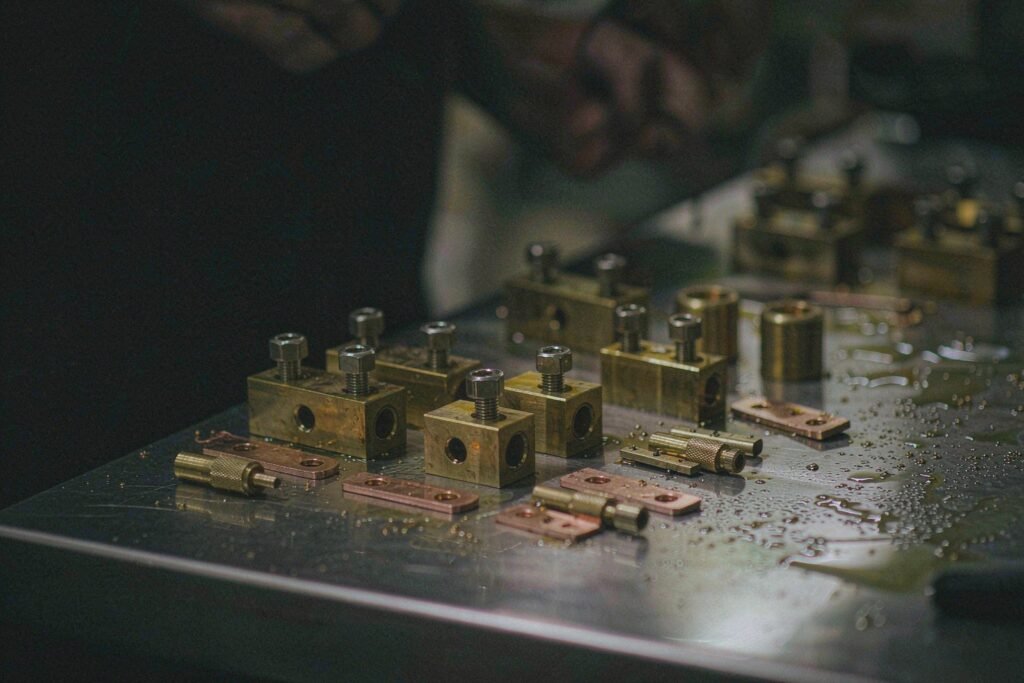
Machined brass terminal blocks with hex socket set screws beside flat copper busbar strips with drilled holes and small knurled brass contact pins
01
Electrical components
Terminal blocks, lugs, connector bodies and contact carriers. The brass body is a housing and a thread; the current path is copper or a plated contact. Tin plating for solderability, silver where the contact slides.
AlloyC36000 / C14500
Conductivity26–93% IACS
Tolerance±0.05 mm
Machined brass precision fittings on a steel bench: threaded hex unions, a compression nut with a conical olive ring, a valve body and a sectioned part
02
Precision fittings
Compression fittings, valve bodies, pneumatic and sensor fittings, threaded adapters. The thread and the sealing face carry the part, so those are the features we hold and inspect. Potable-water work moves to C69300 or a qualified DZR grade.
AlloyC36000 / C69300
ThreadM / BSP / NPT
Tolerance±0.05 mm
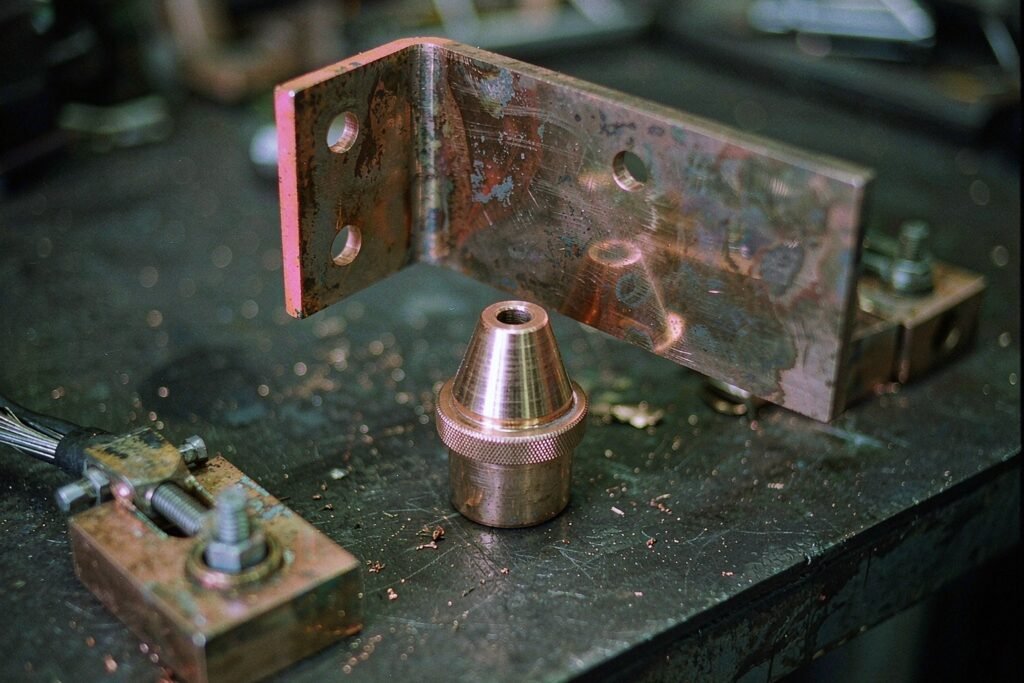
Copper conductive parts on a machine shop bench: a busbar bent at ninety degrees with mounting holes, a tapered welding nozzle with a knurled collar and a ground block
03
Conductive parts
Busbars, welding nozzles, ground blocks, EDM electrodes and RF parts. At radio frequency the current travels in the surface layer — about 66 µm deep at 1 MHz and under a micron at 10 GHz — so the plating, not the core, carries the signal.
AlloyC11000 / C14500
PlatingAg 3–8 µm
Tolerance±0.01 mm
SURFACE AND PLATING

Plating is what turns a brass part into an electrical contact

Untreated brass tarnishes. On a connector that is not a cosmetic problem: the oxide and sulfide film that forms within weeks is an insulator, and contact resistance climbs with it. The finish exists to keep the surface metal the metal you specified.
3–8 µm
2–5 µm
—
TOP · Ag 3–8 µm
BARRIER · Ni 2–5 µm
SUBSTRATE · C36000
Nickel goes on first as a diffusion barrier, then silver for contact resistance and wear, or gold at 0.5–1.5 µm for low-level signals. Because plating grows on both sides of a diameter, 5 µm of tin adds 10 µm to the part — plating and tolerance have to be designed together, not in sequence. XS Precision quotes the stack that way.
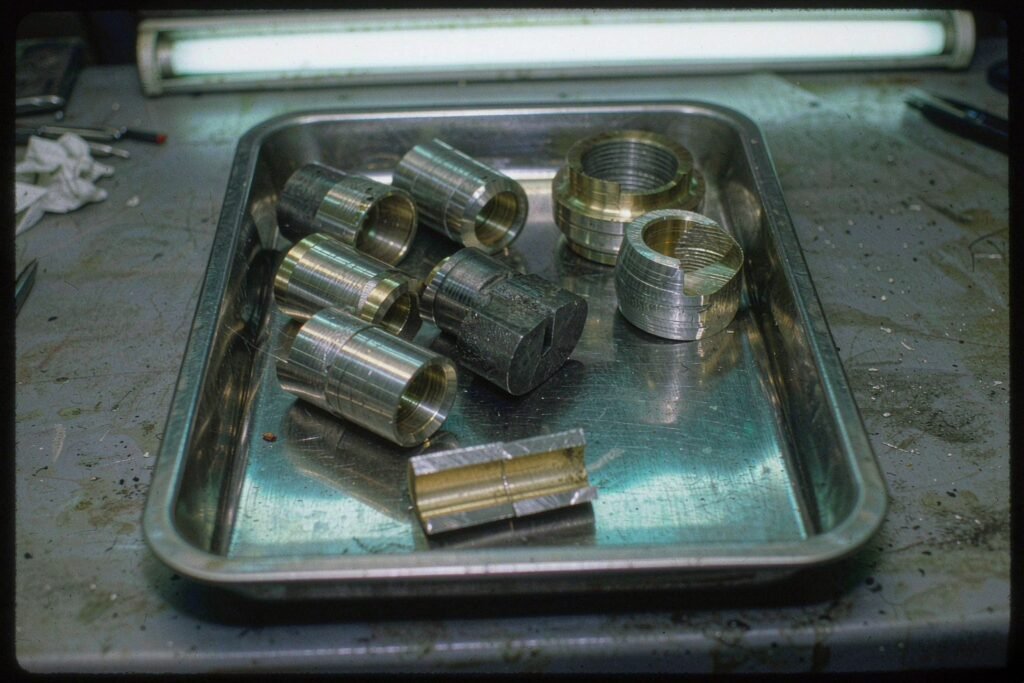
Tin-plated and nickel-plated brass turned parts in a steel tray, one part sectioned to show the plating layer over the brass core

Tin and nickel plated brass parts, one cut through to show the plating layers

Where plating is unwanted: benzotriazole passivation gives a thin anti-tarnish film that does not change dimensions, and a clear lacquer covers decorative hardware. Silver tarnishes in sulfur-bearing air, so a silver-plated contact either gets a barrier layer or a sealed environment.

WHAT FAILS, AND WHY

Three failure modes are behind most brass and copper returns

01
Dezincification
Zinc is leached out of the alloy in warm, low-pH, high-chloride water and leaves a porous copper sponge behind. ISO 6509-1 reports it as a dezincification depth, and most water specifications cap that at 200 µm. The fix is a DZR grade inhibited with arsenic, antimony or phosphorus, usually a naval brass or one of the CZ132 / CW602N family.
02
Stress corrosion cracking
Cold work or heavy machining leaves residual tensile stress. Ammonia, amines and mercury then crack the part months later in service. The old name for it was season cracking, and it is still why refrigeration and agricultural fittings fail. Relief anneal at 250–350 °C, and test against ASTM B858 or ISO 6957 where service calls for it.
03
Hydrogen embrittlement
Electrolytic tough pitch copper carries 0.02–0.04% oxygen. Heat it above roughly 400 °C in a reducing atmosphere and hydrogen meets that oxygen at the grain boundaries, forms steam and cracks the part. Any copper that will be brazed, welded or vacuum processed should be ordered as oxygen-free C10200 or DHP C12200 instead.

One more failure has nothing to do with the alloy and everything to do with the assembly. Copper and brass are cathodic to steel, aluminium and zinc, so in a wet joint the other metal is the one that corrodes — sometimes badly. Aluminium bolted to brass in humid air is a known combination, and it is solved with an insulating washer, a plated fastener, or a change of one side of the joint.

LEAD, ROHS AND DRINKING WATER

The 4% lead exemption has a date and a condition on it

Lead is what makes free-cutting brass free-cutting, so compliance is not a paperwork afterthought on these parts. The rules moved in November 2025 and the dates below are the ones to design against.

≤4% PbROHS ANNEX III 6(c) · RENEWED TO 2027-06-30
Lead as an alloying element in copper alloys up to 4% by weight
Delegated Directive (EU) 2025/2364 renewed exemption 6(c) to 30 June 2027 and added a condition: it does not cover equipment or accessible parts a child could put in the mouth. Anything under 5 cm in any dimension counts as mouthable, unless lead release stays at or below 0.05 µg/cm²/hour and any coating holds that for at least two years.
0.25% PbDRINKING WATER · SDWA / NSF-ANSI 61 / PROP 65
Potable-water parts are judged on a different number
The US Safe Drinking Water Act limits the weighted average lead content of wetted brass to 0.25%, and NSF/ANSI 61 covers the material and the finished component. California Proposition 65 adds a warning obligation. Brass fittings that touch drinking water should be quoted in C69300 or a certified DZR grade, with the certificate attached to the order rather than promised.
INDEX 75-85LEAD-FREE ALTERNATIVES
What you give up when the lead comes out
Silicon brasses such as C69300 and CW724R run at 75–85 on the same machinability scale where C36000 is 100, and they are not automatically dezincification resistant — that has to be qualified per grade. Tool geometry, feeds and thread design usually need changes too. We flag the alloy change before machining, not after delivery.
TOLERANCE, FINISH, INSPECTION

Tight tolerances are routine on brass; the thermometer decides the last digit

±0.05
MM · STANDARD
Turned diameters and shoulders on ordinary brass work, at no extra cost.
±0.01
MM · PRECISION
Routine when the drawing asks for it; needs qualified tooling and a settled machine.
±0.005
MM · HIGH
Temperature control and 100% inspection, so the piece price moves noticeably.
Ra 1.6
µm · STANDARD
Almost automatic on brass with a sharp insert.
Ra 0.8
µm · WIPER
Wiper geometry on a finishing pass, a small cost increase.
Ra 0.1
µm · MIRROR
Diamond or PCD finishing for copper and brass reflectors and waveguides.

Thermal expansion sets the floor on what a number means. Brass C36000 moves about 20.5 µm per metre per kelvin and copper about 17, so a 100 mm part grows roughly 0.02 mm over a 10 °C change. That is twice the ±0.01 mm band, which is why XS Precision states the temperature the report was taken at instead of just quoting the number.
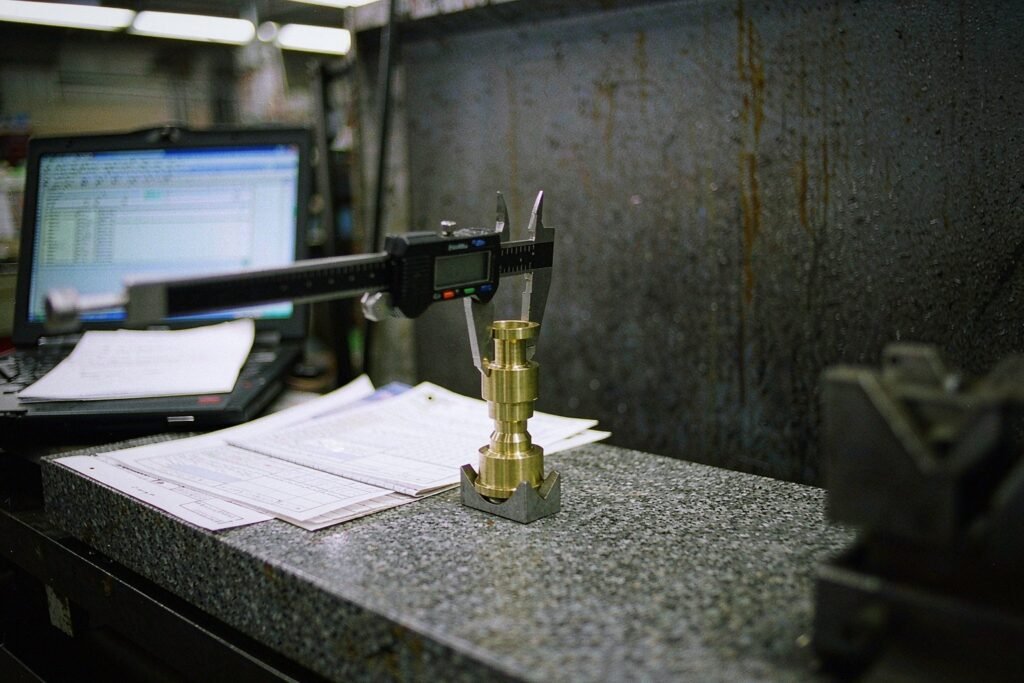
A machined brass fitting held in a V-block on a granite surface plate while a digital caliper measures it, with a blank inspection report beside it

A brass fitting measured on a granite plate during inspection, certificate alongside

Every order ships with a mill certificate to EN 10204 3.1 carrying the heat number, matched to the bar the part was cut from. Positive material identification by XRF separates C36000 from a lead-free grade on the shop floor, which is the mistake that actually happens when two alloys look identical in the rack.

Typical profile on brass: mill certificate, chemical composition, hardness, dimensional report at a stated temperature, plating thickness and, where the drawing calls for it, the ammonia vapour test for residual stress.

WHAT IT COSTS

The bar is expensive; the cutting is cheap

BAR AND HEX STOCK
MACHINING TIME
Free-cutting brass bar has been trading around US$4.00–7.00 per pound, roughly US$8.8–15.4 per kilogram, with LME copper between US$14,000 and US$15,060 per tonne through September 2026 and zinc near US$3,900. That is the expensive half, and it is the half you cannot cut away. The cheap half is the cutting: brass machines at two to four times the speed of stainless steel and about five times titanium’s, so a part that would be quoted on machining time in steel is quoted on material in brass.

Swarf is where some of it comes back. Brass and copper chips are clean, single-material and recyclable at a real discount to bar price, which is why brass, copper, aluminium and steel are bagged separately instead of being swept into one bin. On a part that runs for years, that recovery quietly pays for a percentage of the material.

The other lever is the one drawings forget: bar diameter. Brass is bought by weight, and a part designed around a standard bar size — 20 mm, 25 mm, 30 mm, 45 mm — removes both the material and the handling time that a special size adds. Shenzhen XS Precision will quote the standard-bar version next to the drawing version when the difference is worth having.

WHEN NOT TO CHOOSE BRASS OR COPPER

Four cases where another material is the better answer

01
Heavy load and continuous sliding
Free-cutting brass is not a bearing material. Where a shaft runs loaded and continuously, tin bronze C93200 or aluminium bronze C95400 carries the load with a proper bearing structure and a much longer life. Choose brass for low-load, intermittent sliding and for the part that is meant to wear first.
02
Service above about 200 °C
Brass softens, and copper anneals and creeps. Bolted copper joints relax as they warm up, which is why busbar assemblies use spring washers and why joints that run hot get re-torqued. If the part is hot and loaded, the answer is usually steel or a high-temperature alloy.
03
Strength and conductivity in the same part
Pure copper is soft and brass is not much stronger. Where a contact spring, a loaded conductor or a tool body has to be both strong and conductive, beryllium copper C17200, CuCrZr or a nickel-silicon alloy does the job that no brass can — at a price that should be justified by the function.
04
Fast seawater
Naval brass resists quiet seawater; it does not enjoy high-velocity or aerated seawater, where erosion-corrosion strips the protective film faster than it re-forms. Copper-nickel 90/10 or a qualified DZR grade is the honest answer there, and it costs less than a returned shipment.
QUESTIONS WE GET

Brass and copper questions, answered before the quote

C36000 if lead is allowed on that part and nothing restricts it: it is the fastest and cheapest brass to machine. If the fitting touches drinking water, is sold in California, or can reach a child, specify a lead-free grade such as C69300 or CW724R and confirm the dezincification qualification for that exact grade rather than assuming it.

C36000 is about 26% IACS, which is fine for a terminal body, a pin or a housing and not fine for a current path. The current path is copper: C11000 ETP at 100% IACS and 58 MS/m, or tellurium copper C14500 at about 93% IACS when the part also has to machine well.

That is built-up edge, not a machine fault. Copper welds to the cutting edge under the pressure and temperature of the cut, then breaks away and takes part of the surface with it. The fix is a sharp insert with a high positive rake and a polished rake face, a heavier feed with a lighter depth of cut, a non-staining lubricant, and a separate finishing pass.

Yes for C36000. The lead phase lubricates the cut and the chips carry the heat away, so dry cutting or a micro-mist is normal. At high spindle speeds a mist keeps the tool and the part at a stable temperature. Copper is different: a non-staining lubricant is worth having, and any fluid with active sulfur or chlorine is kept away from it.

Three things. Relief anneal cold-worked or heavily machined parts at 250–350 °C to remove residual tensile stress. Keep ammonia, amines and mercury out of the environment, including cleaning agents. And where the fitting sees warm chlorinated water, specify a DZR grade with ISO 6509-1 evidence rather than a general-purpose brass.

Both. Every order carries a mill certificate to EN 10204 3.1 with the heat number matched to the bar the part was cut from, plus PMI and a dimensional report at a stated temperature. ±0.01 mm is routine on turned brass; ±0.005 mm is available with temperature control and 100% inspection.

WHERE TO GO NEXT

Related capability and material pages to read next

Precision CNC machining

3-, 4- and 5-axis milling and turning, including the brass and copper speeds, tool geometry and chip strategy described above.

High-precision components

Bores, threads and sealing faces held on brass and copper, with the inspection report to match.

Brass and copper against stainless

The other side of the same decision — where corrosion resistance or strength beats conductivity and machinability.

Send the drawing. We will tell you which alloy fits.

A STEP file, the service environment, the mating materials and the features that matter are enough to start. If a lead-free grade or a different material is the better answer, you will hear that before the quote rather than after the parts arrive.

Or send the drawing to info@xsprecisiontech.com with the alloy and the quantity and we will come back with the machining route, the tolerance we can hold and the certificate package.

Request a quote today!