ASSEMBLY SERVICES · ENGINEERING SOLUTIONS

Assembly Services that take a machined part to a tested unit

Machining gives you parts that measure right. Assembly is where those parts have to work together, and where most of the arguments start. XS Precision builds mechanical sub-assemblies, cable terminations and complete box builds in the same building that cut the metal — so the fit, the torque and the test record belong to one supplier instead of three.

The three questions behind almost every assembly enquiry are ownership (who pays when a unit fails), evidence (what record ships with it) and revision control (which BOM revision was actually built). This page answers all three before you send us a file.
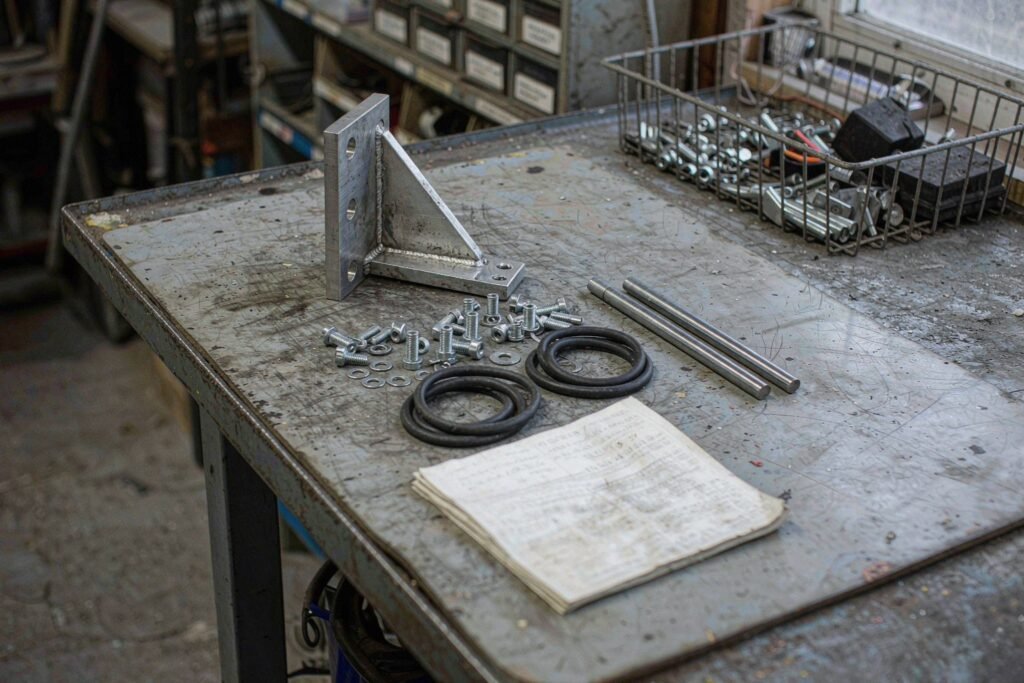
One build worth of components laid out in grey compartment boxes on a worn ESD bench mat: a machined aluminium L-bracket with a gusset, socket-head cap screws, spring washers, O-rings, dowel pins and a folded traveller sheet
SIX NUMBERS THAT DECIDE HOW THE BUILD IS SET UP

Assembly is quoted on evidence and on cycle time, not on hourly rate alone.

10 %
of applied torque becomes clamp load
About 40% is lost to thread friction and 50% to friction under the head. Torque and clamp load are not the same number.
34 %
South China share of China’s EMS revenue
China’s contract assembly market is roughly $268bn in 2026, and the Pearl River Delta accounts for about a third of it.
9.7 %
global EMS CAGR to 2029
From about $1.04tn in 2024 to roughly $1.65tn in 2029 — outsourced assembly is outgrowing electronics as a whole.
100–5,000 units/yr
where box build pays best
Under about 50 units the integration overhead rarely pays back; above 5,000 the line should be dedicated.
30–60 %
final assembly time saved by sub-assembly
One station repeats one module instead of switching tasks across the whole unit.
1.4 years
cobot cell payback, 2026
Down from 2.8 years in 2023. Automation capability, not wage arbitrage, now decides who wins assembly work.
WHAT WE ACTUALLY PUT TOGETHER

Three kinds of work, one build record

Assembly Services at XS Precision cover three kinds of work, and all of it happens on the same floor as the machining, which matters more than it sounds: when a housing does not fit the bearing it was machined for, the fix is a conversation across the bench, not a claim across three companies.
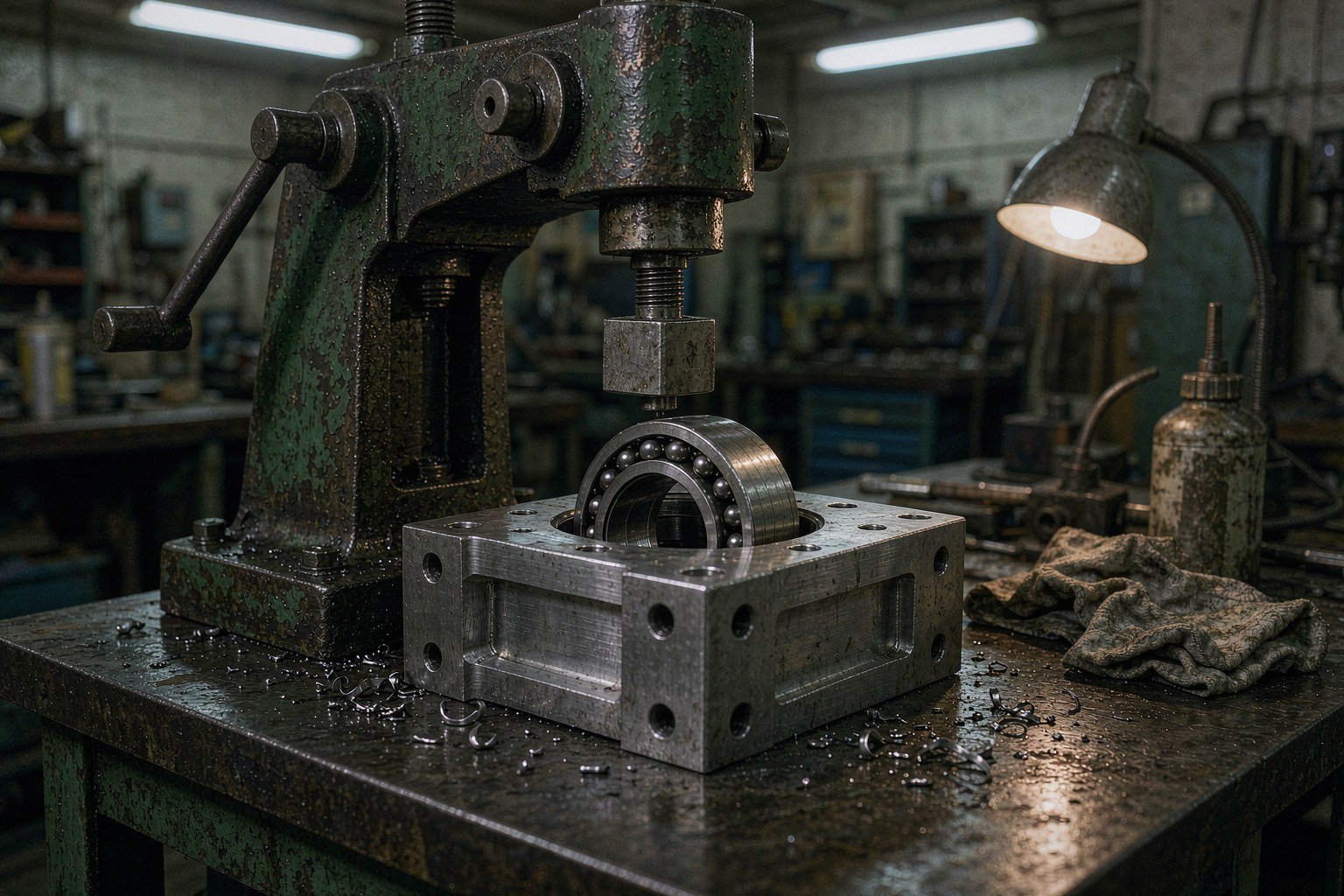
A hand-operated arbor press fitting a steel ball bearing into the bored central seat of a machined aluminium housing, the ring of bolt holes and ribbed side walls visible under the ram
MECHANICAL
Press fits, bearings and bolted sub-assembly
Bearing and bushing installation, dowel alignment, bolted flanges with a written tightening sequence, and the torque record that goes with it. This is the work where “hand-tight” turns into a field failure six months later.
Typical envelope50–600 mm
Interference fitsH7/r6 – H7/p6
Fastener rangeM2 – M12
Recordper-unit torque log
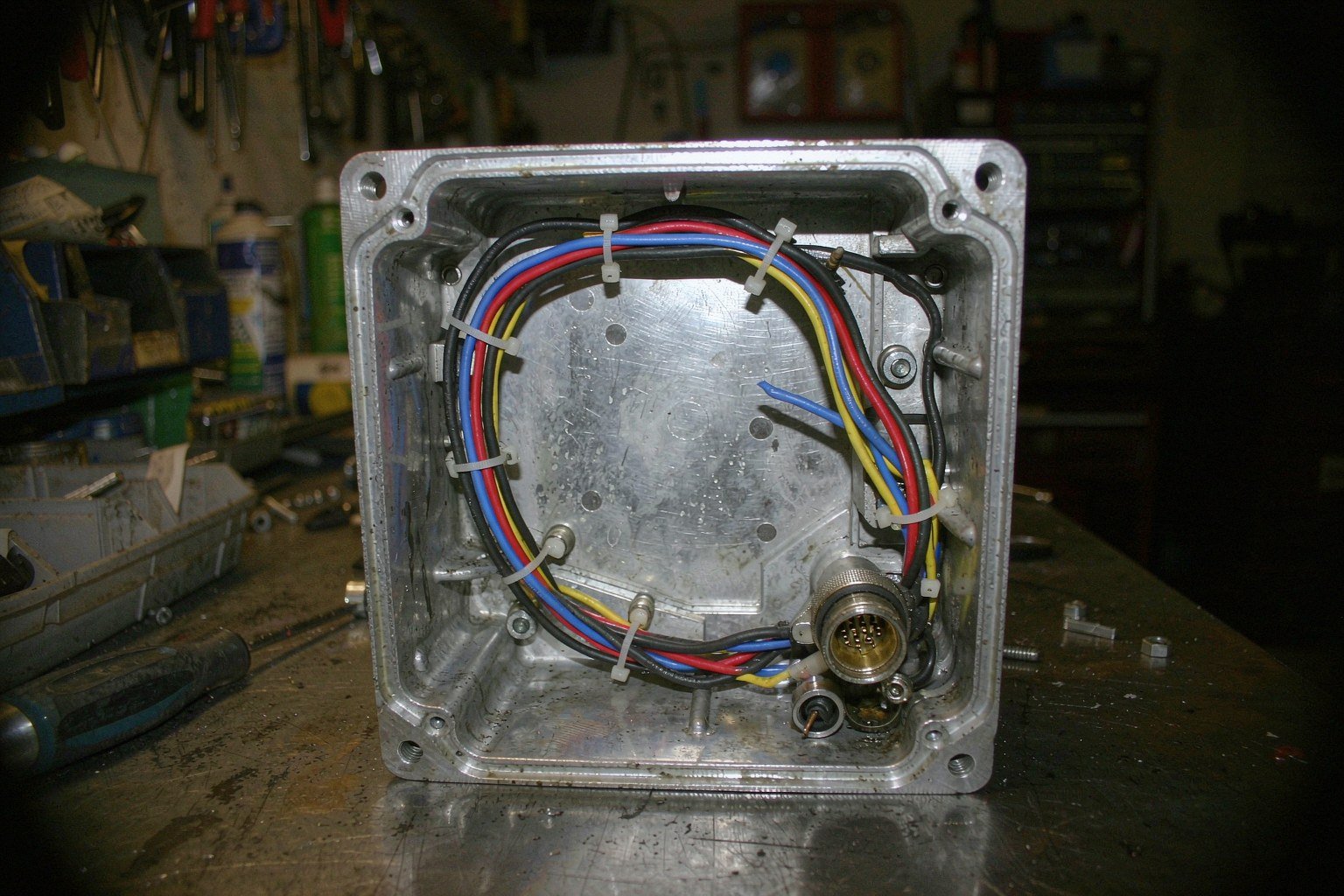
A cable harness routed along the inside wall of an open machined aluminium enclosure, eight insulated wires held by nylon cable ties on tie-down studs, ending in a circular metal-shell connector with a coupling ring
CABLE & TERMINATION
Harness routing, crimping and connector termination
Cut to length, terminated, labelled and pulled-tested, then routed with real strain relief. Cable routing is where field failures most often originate, so we treat the tie-down anchors as a design requirement rather than a suggestion.
Conductor range0.14–6 mm²
WorkmanshipIPC/WHMA-A-620
First-off checkpull force per crimp
Recordcontinuity + pull test
An end-of-line functional test station: a machined aluminium test nest with pogo-pin contact blocks and a hinged clamp lid, bench power supply, laptop test log and a green pass indicator
BOX BUILD
Complete units: boards, wiring, enclosure, test
The full integration step. Tested boards, harnesses, machined enclosures and bought-in hardware become one serialized unit with a functional test result attached to its serial number.
Volume band100–5,000 / yr
Functional test100% of units
Recordserial-level build file
Typical lead2–6 weeks
THE NUMBER MOST OFTEN SPECIFIED WRONG

Torque is not clamp load. Roughly 10% of what you apply reaches the joint.

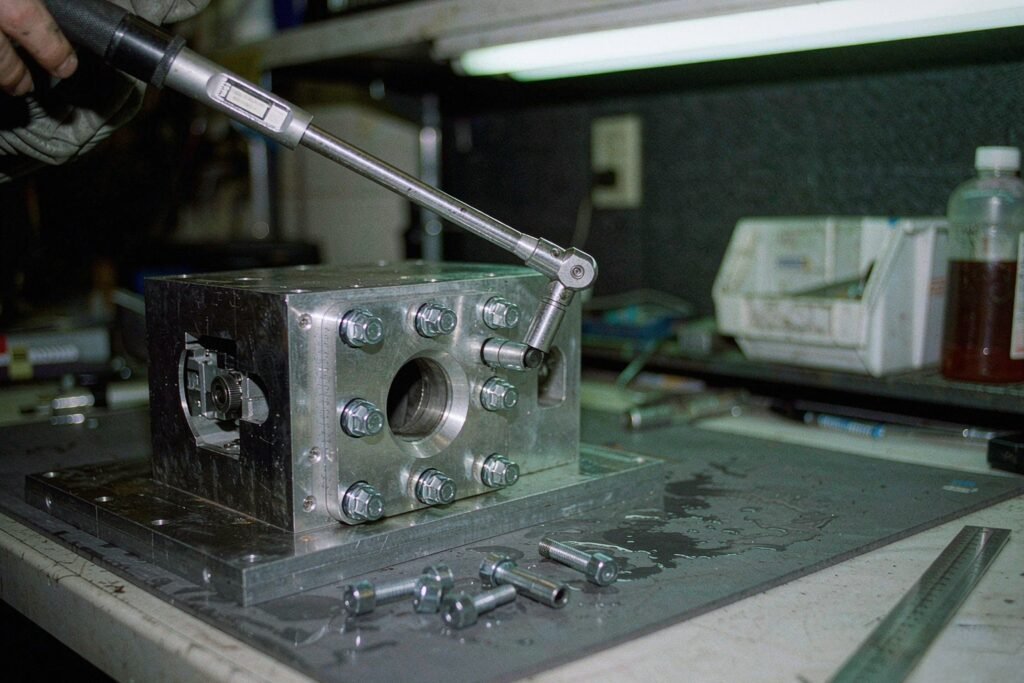
Of the torque you put on a fastener, about 40% is consumed by friction in the thread and about 50% by friction under the bolt head or nut face. Only what is left — typically around 10% — becomes the clamp load that actually holds the joint together. That split is why two assemblies built to the same torque value can have very different preload: change the lubricant, the plating or the washer material and the friction term moves.
50%
40%
10%
Friction under the head or nut face
The largest single term. Controlled by surface finish, plating, washer type and whether the face is lubricated.
Friction in the thread
Controlled by thread condition, tolerance class, lubricant and whether the hole is tapped or a nut is used.
Clamp load in the joint
The only part doing useful work. If you need this as a design variable, you have to control friction first.
A click-type torque wrench engaged on a hexagon-head cap screw in the bolted flange of a machined aluminium housing clamped to a steel assembly fixture, knurled handle and scale window visible on a grey ESD bench mat
Instead of
“Torque to 8 N·m” on the drawing, nothing else.
→
Write this
“Torque to 8 N·m ±4% with a calibrated tool, thread lightly oiled, zinc-plated washer, angle monitored at 25–30°.” The friction terms have to be named, not assumed.
Instead of
“Tighten securely” or no callout at all.
→
Write this
A torque value for every fastener size, plus a tightening sequence for any bolt circle. Sequence is what stops a gasket or a flange being pulled out of flat.
Instead of
“We check torque at final inspection.”
→
Write this
A torque–tension check on first-off, and a current calibration certificate for every tool used. ISO 6789-2 allows ±4% of reading for indicating tools and ±4% of setting for setting tools, measured at 20%, 60% and 100% of range.

On calibration intervals. ISO 6789-2 does not fix a mandatory period; it requires recalibration after commissioning, after any repair or suspected overload, and at a defined interval. Industry practice is 12 months for moderate use and 6 months for high-cycle stations. XS Precision logs every torque tool against its certificate, and a tool that goes out of date is pulled from the bench rather than argued about.

WHAT ACTUALLY HAPPENS TO YOUR JOB

Seven stations between the drawing and the pallet

None of these steps is exotic. What separates a build that ships from a build that comes back is that every one of them has a written output, and the next station cannot start without it.

01
Drawing and BOM release
Revision frozen. We confirm which revision we are quoting and what we are buying.
02
Incoming inspection
Every bought-in part checked against the AVL, logged with lot and supplier certificate.
03
Kitting
One kit per unit, picked against the frozen BOM, with lot numbers attached.
04
Sub-assembly
Press fits, bearing installation, harness build and module test before they meet the enclosure.
05
Final assembly
Torque to value and sequence, cable routing and strain relief, labels and serials applied.
06
Test
Functional test at 100%, plus whatever else the drawing calls out, logged against the serial.
07
Pack and dispatch
Foam inserts cut to a real article, carton drop-checked, packing list and build file shipped together.
Gate
Incoming
Criteria: Part matches AVL and drawing revision
Evidence: Goods-in record with lot and certificate number
Gate
Kitting
Criteria: Kit complete against the frozen BOM
Evidence: Kit sheet signed, shortages raised before build starts
Gate
Build
Criteria: Torque value, sequence and routing followed
Evidence: Per-unit torque log and operator sign-off
Gate
Test
Criteria: Passes the agreed test script
Evidence: Serial-level result file, failures quarantined
Gate
Dispatch
Criteria: Serial, labels and packing match the order
Evidence: Packing list, build file and certificate of conformance
WHO OWNS THE MATERIAL, AND WHO OWNS THE FAILURE

Turnkey, consignment or hybrid — choose by what you need to control, not by price

Assembly Services are priced on this choice more than most buyers expect, and it is worth ten minutes before the quote. Turnkey means we buy everything and you get one invoice. Consignment means you supply the material and we supply the process. Consignment is usually described as a cost tactic, which misses the point: for medical, aerospace and defence programs it is how you keep an approved vendor list, a lot genealogy and a chain of custody that an auditor will accept. Most of our customers end up on the hybrid column — they buy the long-lead and the controlled parts, we buy everything else.

What you are deciding
Turnkey
Consignment
Hybrid
We source the material
✓
—
○
You keep approved vendor list control
—
✓
○
Lot traceability depth
○
✓
✓
Counterfeit exposure
○
✓
○
Your working capital tied up
—
✓
○
Your procurement overhead
—
✓
○
Long-lead parts pre-positioned
✓
—
✓
One party owns the failure
✓
—
○
Realistic for 100–5,000 units/yr
✓
○
✓

Full mark = yes, open circle = partial, dash = no. The pattern to notice is that turnkey wins on overhead and accountability while consignment wins on control. If your end customer audits the supply chain, the control column usually outranks the price column — and if nobody audits it, the overhead column does. XS Precision will quote either way and will say which one we think your program actually needs.

THE MOST COMMON SOURCE OF A WRONG BUILD

A kit is only correct if it was picked against the BOM revision you approved

Two units built six weeks apart can behave differently without anyone making a mistake, simply because a connector was substituted or the BOM moved by one revision and the change note never reached the bench. Revision control is not paperwork for its own sake — it is the only thing that makes a second batch comparable to the first.

✓
One frozen revision at kitting
The kit is picked against the exact BOM revision quoted, and any change after that point goes through a written change note before the next unit is built.
✓
Lot numbers captured at goods-in
Not at final test. If a supplier issues a recall on a lot, you want to know which serials contain it without opening cartons.
✓
Shortages raised before build starts
A missing part discovered at station five costs a partly built unit. Discovered at kitting it costs a purchase order.
✓
Substitution is a decision, not a workaround
An equivalent part is quoted, approved and recorded. Silent substitution is the single fastest way to lose a customer’s trust.
✓
Minimum order quantities dealt with honestly
A bought-in part with a 5,000-piece minimum on a 200-unit order is a real cost. We show it as a line item rather than hiding it in the unit price.
✓
Last-time-buy flagged early
If a part is going end-of-life inside your build horizon, you need to know before the quote, not after the first batch.
WHEN “LOOKS CLEAN” IS NOT A CLASS

ISO 14644-1 is a particle ceiling, and every class step is a factor of ten

A normal machine shop is an uncontrolled space. That is fine for a bracket and meaningless for an optical assembly or an implant. The classification is a limit on airborne particles at a stated size — most specifications quote 0.5 µm — and each class down allows ten times fewer of them per cubic metre.

ISO 5
3,520 /m³
Aseptic filling, lithography
Unidirectional airflow and full gowning. Far beyond what a machining shop can hold; we quote this through a partner facility rather than pretending to it.
ISO 6
35,200 /m³
Semiconductor support, precision assembly
HEPA ceiling coverage, controlled gowning, particle monitoring at rest and in operation.
ISO 7
352,000 /m³
Medical device assembly, precision optics
What most “clean assembly” requests actually mean. Gowning, sticky mats, dedicated airflow and a monitoring log.
ISO 8
3,520,000 /m³
General assembly and packing
The usual floor for industrial electronics assembly and for packing medical devices.
ISO 9
35,200,000 /m³
Unclassified industrial space
Roughly where a standard workshop sits. Perfectly adequate until a customer asks you to prove it is not.
Assembly inside a glove-port acrylic enclosure on a perforated stainless cleanroom bench, HEPA filter ceiling grid above and a machined part in a stainless tray held by gloved hands

Two things to put in writing. First, the state: ISO 14644-1 recognises as-built, at-rest and operational, and a room that holds ISO 7 at rest will not necessarily hold it with two people working in it. Unstated, that difference is where acceptance arguments start. Second, electrostatic discharge: if the assembly carries unprotected electronics, ask for ANSI/ESD S20.20 control, where dissipative surfaces sit in the 106–109 Ω range. It is cheap to do and expensive to discover you needed.

WHAT “TESTED” HAS TO MEAN IN WRITING

Functional test, dielectric and burn-in run at 100%. Environmental, IP and vibration usually do not.

This is the section that causes the most friction after delivery, because “tested” means different coverage to the buyer and to the assembler. A 100% functional test tells you the unit worked at the station. A sampled vibration test tells you the design survives a profile — it does not tell you anything about the unit in the carton.

Functional test
100%
Criteria: Unit performs its specified function at the station
The test script is the contract. Agree what it exercises before the fixture is built, because changing it later changes the fixture.
Hipot / dielectric
100%
Criteria: Isolation between primary, secondary and chassis at a stated voltage
Safety-relevant and normally 100%. The test voltage and the leakage limit belong on the drawing, not in an email.
Burn-in / run-in
100% or by plan
Criteria: Continuous loaded run to catch early-life failure
Hours and load profile drive the cost. State whether it is every unit or a sample, and what happens to a unit that fails.
Leak / pressure
100% where applicable
Criteria: Sealed enclosure holds or decays within a stated limit
Pressure decay, helium or submerged bubble — name the method and the number, or there is nothing to argue from.
Environmental
Sample per batch
Criteria: Performance at temperature and humidity extremes
This validates a design. It will not catch a badly crimped terminal in unit 43 of 200.
IP rating
Sample per design
Criteria: Ingress protection against dust and water
Per design revision, not per unit — and it has to be repeated after any enclosure or gasket change.
Vibration
Sample per design
Criteria: Mechanical integrity under a defined profile
If a customer genuinely needs 100%, it stops being a test and becomes a screen, and the fixture cost changes accordingly.
A digital torque tester with an LCD readout and hex-drive transducer beside a bolted steel test coupon in a vice, a calibration certificate folder and a spiral-bound torque audit log book

Three questions to settle before the fixture is cut. Who pays for the test fixture — it is a real one-off cost and it belongs to whoever paid for it. Who owns the test script, including the right to take it to a second supplier. And what the disposition is for a unit that fails: rework, use-as-is with your written approval, or scrap. Answer those three at quotation stage and the test station stops being a negotiation.

NAME THE DOCUMENT, THE REVISION LETTER AND THE CLASS

“Build to IPC” is not a specification

An assembly standard only binds anyone if the purchase order names the document, the revision letter and the class. Everything else is a preference, and a preference is not something you can reject a batch against. IPC itself became the Global Electronics Association in June 2025; the document numbers did not change, but the revision letters do roughly every three years.

IPC-A-610J
Acceptability of electronic assemblies
Current revision, March 2024. The “target” condition was removed; an outcome is acceptable, a process indicator, or a defect. It sets criteria, not sampling plans.
IPC J-STD-001J
Requirements for soldered assemblies
The process companion to A-610 — materials, methods and acceptance. Automotive addendum J-STD-001JA is out; the K revision is in draft.
IPC/WHMA-A-620
Cable and wire harness assemblies
Crimp height, pull force, insulation damage. This is where most “it worked on the bench” failures actually live.
ISO 6789-1 / -2
Hand torque tool calibration
±4% of reading for indicating tools and ±4% of the set value for setting tools, verified at 20%, 60% and 100% of range.
ISO 14644-1:2015
Cleanroom classification
A particle ceiling per cubic metre. Always state the class and the state — as-built, at-rest or operational.
ISO 13485 / AS9100D
Medical device and aerospace quality systems
ISO 13485 drives the device history record; AS9100D adds configuration management and counterfeit-part control.
ANSI/ESD S20.20
Electrostatic discharge control
Dissipative surfaces sit in the 106–109 Ω range. Require it whenever the assembly carries unprotected electronics.
IATF 16949
Automotive quality management
Requires ISO/IEC 17025 accredited calibration. Ask which revision a certificate covers and when it expires — certification runs 24 months.

The habit worth forming: write “fabricate and assemble to IPC-A-610J Class 2, solder to J-STD-001J, harness to IPC/WHMA-A-620” on the order rather than “per IPC”. It costs one line and it removes the most common argument in incoming inspection.

WHERE THE ONE-OFF MONEY ACTUALLY GOES

Assembly quotes are usually decided by the fixture, not by the labor rate

Labor is the number everyone negotiates and rarely the number that matters. A functional test nest, a harness pull-test fixture and a set of foam inserts are one-off costs that dwarf a few cents an hour — and if they are missing from the first quote, they reappear later as a surprise. The ranges below are directional, based on typical programs rather than audited averages; the point is the relative size, not the exact figure.

Enclosure tooling$500–$50,000
Sheet metal sits at the cheap end; injection molds and die cast tooling at the expensive end. A machined enclosure usually avoids this line entirely, which is why it wins at low volume.
Harness tooling$200–$2,000
Custom connector termination, overmolding and a pull-test fixture. Small unless the connector is unusual.
Test fixture$500–$10,000
Functional test nest, pogo-pin interface, burn-in rack. The line item most often absent from a first quote, and the one that hurts most when it is added later.
Packing design$300–$3,000
Die-cut foam inserts and carton sizing. Cheap to do properly, expensive to redo after a transit failure.
First-off and verification$200–$1,500
First-article measurement, torque–tension check, and the build file that makes the second batch comparable to the first.

Assembly labor itself is usually quoted per minute at the station, and the spread between a simple bolted sub-assembly and a routed harness with a test loop is roughly twenty-fold. That is why the drawing matters more than the rate: every flip of the unit mid-build adds 15–30 seconds, and every connector a technician cannot reach adds more.

WHAT WE NEED BEFORE WE CAN PRICE IT HONESTLY

Six answers that move an assembly quote more than anything else

Outsourced Assembly Services fail on missing information far more often than on capability. A quote built on assumptions is a quote you cannot hold anyone to, so these are the six answers we ask for before pricing a build.

✓
The assembly drawing and the BOM at the same revision
Mismatched revisions are the single biggest cause of a quote that has to be reissued. We check this before costing, not after.
✓
A torque value and a sequence for every fastener
Without it we have to assume a friction condition, and an assumption is not something you can hold us to later.
✓
The test you want, and whether it is 100% or sampled
This is what sets the fixture cost. “Test it” is not quotable.
✓
Which parts you supply and which you want us to buy
That is the turnkey / consignment decision from earlier, made part by part rather than all at once.
✓
The environment the unit has to survive
Temperature range, ingress rating, vibration, and whether any of it needs to be proven or just designed for.
✓
How many now, and how many per year after that
A 20-unit build and a 2,000-unit build are different processes. Telling us both lets us design the station once.
THE LAST STATION IS WHERE UNITS GET DAMAGED

Serial numbers, labels and packing are part of the build, not an afterthought

A unit can pass every test on the bench and still arrive with a cracked housing, because the foam insert was cut to the CAD model instead of to a real article, or because the carton was sized after the units were already packed. We cut inserts from a physical part and drop-check the first packed carton before releasing the rest.

Serialization is the other half. A serial number is only useful if it points at something: the BOM revision, the lot numbers that went in, the torque log and the test result. We keep that as one build file per serial, so a question from your customer eighteen months later is a lookup rather than an investigation.
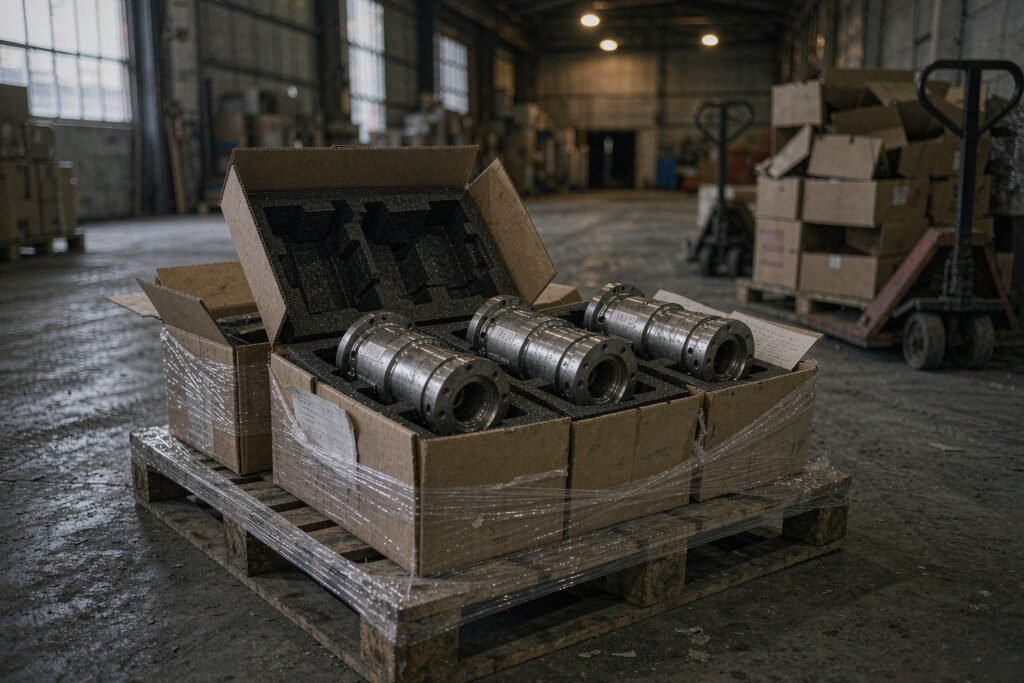
Three finished machined aluminium assemblies nested in die-cut black foam inside brown corrugated cartons on a wooden pallet, serial labels applied and stretch wrap part-wrapped in a dispatch bay
THREE WAYS AN ASSEMBLED UNIT QUIETLY GOES WRONG

All three are preventable at quotation stage and expensive once the material is on the bench

01
A unit fails at your customer and nobody owns it
Root cause
The machined housing measured in tolerance and the bought-in bearing met its catalog spec, so both suppliers are technically correct.
What we do
One supplier owns the assembled unit and its test record. XS Precision diagnoses the failure instead of you arbitrating it between two invoices.
02
Two units built six weeks apart behave differently
Root cause
A fastener or connector was substituted, or the BOM moved a revision and the change note never reached the bench.
What we do
Revision freeze at kitting, lot capture at goods-in, a serial-level build record, and a written approval before any substitution.
03
The unit passes bench test and fails in transit
Root cause
Packing was specified after the build, and the foam inserts were cut to the model rather than to a real article.
What we do
Packing designed alongside the build, inserts cut from a physical part, and a drop check on the first carton before the rest ship.
ASSEMBLY QUESTIONS, ANSWERED BEFORE THE QUOTE

The six questions that come up on nearly every assembly enquiry

Every Assembly Services enquiry we field contains some of these, usually in roughly this order. The answers below are the ones we would give on a call, including the ones that cost us the job. XS Precision assembles what we machine, what you supply, and mixtures of the two.

Yes, and it is about half the work. Bought-in bearings, linear rails, power supplies, connectors and boards all arrive at goods-in and get inspected against your approved vendor list before they are kitted. Machining the enclosure in-house simply removes one handoff and one argument about fit.

One unit, honestly — but be aware that below roughly 50 units the documentation and fixture setup is a large share of the cost, so the unit price looks worse than it should. Between 100 and 5,000 units a year is where a proper box build setup pays for itself.

ISO 8 and ISO 7 in-house for assembly and packing, with gowning, sticky mats and a particle monitoring log. ISO 6 and ISO 5 are quoted through a partner facility and priced accordingly — we would rather say that up front than fail an audit later.

Whoever pays for it, which is usually you, and we say so on the quote. The script is yours to take to a second supplier. If you would rather we absorb the cost into the unit price, that is possible too — it just changes what the unit price has to be.

As standard: a certificate of conformance, the packing list, and the build file for each serial — BOM revision, lot numbers, torque log and test result. First-article reports, calibration certificates and full traceability packages are available where the end use warrants them.

A written change note, a re-quote for the delta, and a decision on what happens to work in progress. Units already built stay on the old revision and are labelled as such. We do not quietly mix two revisions in one shipment, and we will tell you the cost and the schedule effect before we move.

Send the assembly drawing and the BOM. We will tell you which parts we should not be buying.

Assembly Services only pay off when the supplier can be held to a number, so here is ours: we tell you what we can verify and what we cannot. Tell us what the unit has to do, what has to be tested, which parts you already own and how many you need this year. If a machined enclosure beats a molded one at your volume we will say so, and if the test you have specified cannot be run at 100% without a fixture cost you did not budget for, we will say that too — before the first kit is picked.

Request a quote today!