Material Expertise · Shenzhen XS Precision

Engineering Materials for CNC Machining Services

We machine a wide range of engineering materials for precision CNC components used in automation, semiconductor, medical, optical and industrial applications. The grade you write on the drawing is not a detail — it sets the cutting speed, the number of setups, the inspection method and the price, in that order.

STEP / STP / IGES / PDF / DWG / DXF  ·  material certificate with every batch  ·  selection support inside the quotation
five requirements · six material families
materialstrengthcorrosionmachinabilityheatcost
scaleEach row is a five-step judgement against one requirement, not a data-sheet value: five filled dots means the material makes that requirement easy, one dot means it fights you. Where two materials tie, the deciding column is usually cost efficiency.
01 · overview

Why material selection decides the quotation

Material selection is a critical factor in CNC machining performance, cost and product reliability. Change the grade on an unchanged drawing and the cutting speed can move by a factor of fifteen, tool life by a factor of ten, and the quotation by two to four times. That is why the material decision is not a line on a spec sheet — it is the first thing a process plan has to settle, and the reason a quotation at XS Precision comes with a recommendation rather than only a price.
15×
Cutting speed spread across our material range
Aluminum runs at 300–600 m/min, titanium at 20–40 m/min. The metal decides the machine time before the drawing does.
2–4×
Price difference on an identical part
Same geometry, same tolerances, different grade. Most of the gap is cutting time, tool life and the finishing operation that the grade forces on you.
±0.4 mm
What one hot finishing operation can move
Anodizing, plating and heat treatment all change the part after it measured good. The allowance has to be in the drawing, not discovered at goods-in.
MATERIAL STOCK, AS IT ARRIVES
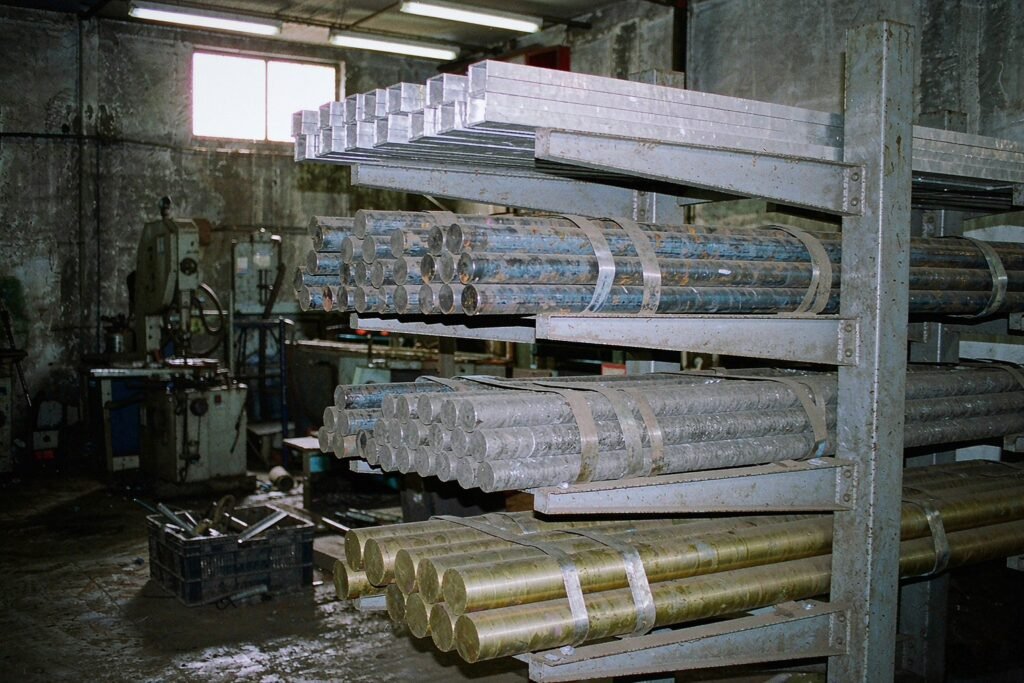
Raw material bar stock in a cantilever rack: bright aluminium blocks, dark mild steel round bar with mill scale, dull stainless steel bar and yellow brass hex bar, a band saw and offcuts bin behind
Raw material stock photographed where it is booked in: aluminum blocks, mill-scale steel bar, stainless bar and brass hex. Every piece is logged with its heat lot, because a material decision you cannot trace is not a decision you can repeat.
four things the material decides before anything is cut
Machining cost. Cutting speed, tool life and the number of setups follow the material, not the shape. A grade that work-hardens costs you twice: once in time, once in tools.
Dimensional stability. Residual stress, heat growth and moisture uptake all move a finished part. Aluminum releases stress when you remove material, PEEK releases it when it takes on water, and a heat-treated steel part moves most during the quench.
Surface finish quality. Some materials are simply easier to bring to a low Ra: aluminum and brass cut clean, 304 smears and work-hardens, titanium galls at the tool edge, plastics melt if the feed is wrong.
Product lifetime. Corrosion, wear and fatigue belong to the grade, not to the tolerance. A 316L part and a 303 part can measure identically on the day they ship and differ by years in service.
02 · material categories

Six material families we machine every week

Each family below has its own page, and each page is written the same way: grades, what the family is genuinely good at, where it typically ends up, and the point where it fights back. The table is a starting point; the rows after it are the honest version. All six families are machined in-house at Shenzhen XS Precision, on the same floor as the inspection equipment.

MaterialCommon gradesTypical usePage
Aluminum Alloys6061 · 6082 · 7075Automation components, structural parts, electronic housingsgo →
Stainless Steel303 · 304 · 316 · 17-4PHMedical devices, industrial equipment, marine componentsgo →
Carbon SteelC45 · alloy steelMechanical structures, load-bearing partsgo →
Brass & CopperCuZn39Pb3 · C11000Electrical components, precision fittings, conductive partsgo →
TitaniumTi-6Al-4V (Grade 5) · Grade 2Medical implants, aerospace components, high-performance partsgo →
Engineering PlasticsPOM · PEEK · PTFE · PA (Nylon)Insulating parts, wear components, precision mechanical systemsgo →
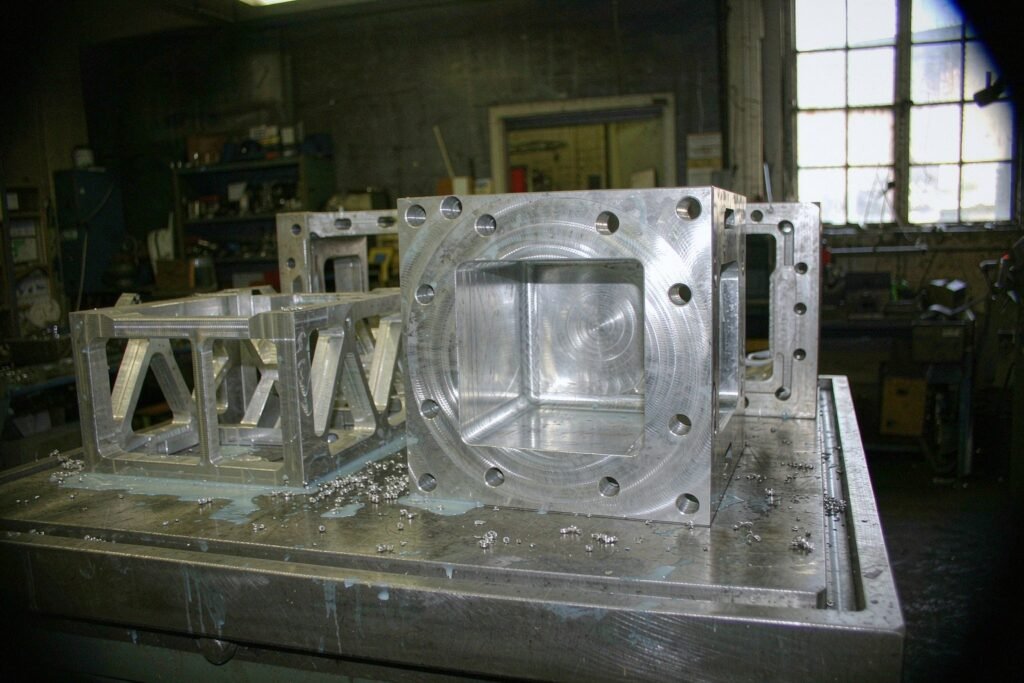
Machined aluminium parts on a steel bench: a 6061 housing with a milled cavity and a ring of bolt holes, a thin-walled frame with lightening pockets and an extruded mounting bracket with slotted holes
01 · MATERIAL

Aluminum Alloys

The default choice for anything that has to be light, stiff enough and cheap to produce in volume. 6061-T6 is the workhorse; 6082 is the European equivalent with slightly better strength; 7075 is the aerospace grade and the one that punishes you for the extra zinc.

grades
606160827075
key advantages
LightweightGood machinabilityHigh strength-to-weight ratio
applications
Automation componentsStructural partsElectronic housings
where this material bites
thin wallsElastic modulus is about a third of steel, so a 1.5 mm wall moves under a 0.3 mm finishing cut. Rough and finish in separate operations, remove material symmetrically, and leave the wall for last.
anodizingSulfuric anodizing adds 5–25 µm per surface. The tolerance on the drawing has to be a pre-finish size or the part arrives oversize and hard.
02 · MATERIAL

Stainless Steel

Chosen for corrosion resistance and cleanliness rather than for strength alone. 303 is the free-machining grade and the only one that behaves like a normal material; 304 and 316 are the ones customers ask for and the ones that work-harden in front of you.

grades
30330431617-4PH
key advantages
Corrosion resistanceHigh strengthGood durability
applications
Medical devicesIndustrial equipmentMarine components
where this material bites
work hardeningA light finishing pass below 0.05 mm per tooth rubs instead of cutting, and the surface gets harder with each pass. Feed properly, keep the cutter moving, and never dwell in one spot.
17-4PH stateThis grade is only as good as its heat treatment. H900 gives about 1,310 MPa; the same part in the solution-treated condition is roughly a third of that and looks identical.
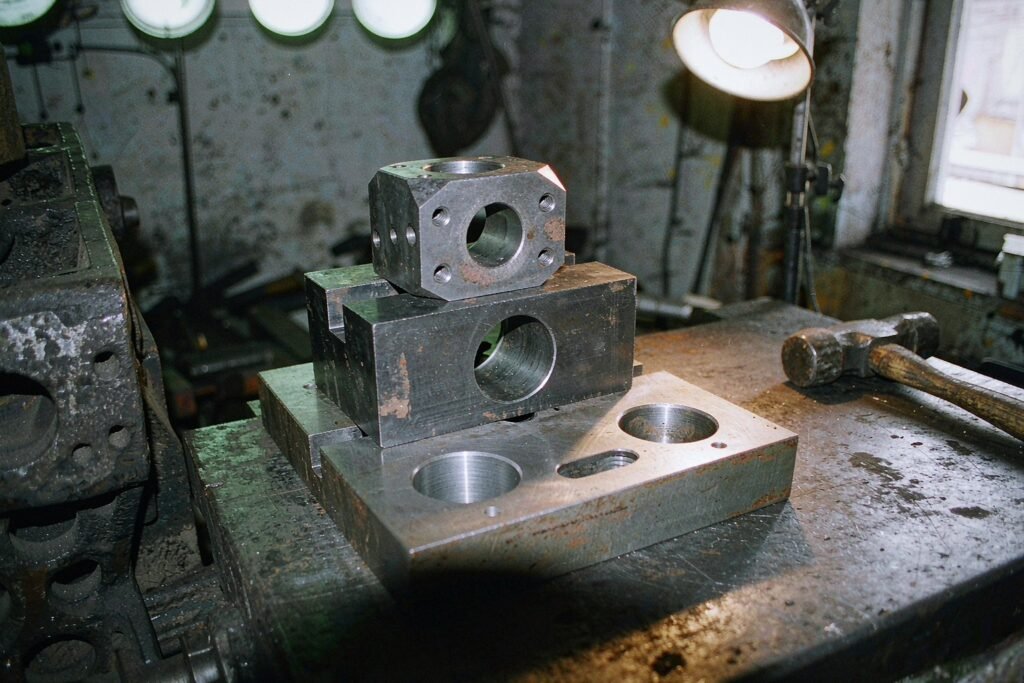
Stainless steel machined components on a perforated steel tray: a 316 housing with a threaded bore and polished sealing face, a 17-4PH bracket with precision bored holes and a turned stainless shaft
Carbon and alloy steel machined parts on a workbench: a thick C45 base plate with bored holes, a black-oxide load-bearing block with a keyway and a hex coupling body with radial tapped holes
03 · MATERIAL

Carbon Steel

Where stiffness, mass and cost matter more than corrosion resistance. C45 and alloy steels take a heat treatment and hold it, which is why machine frames, shafts and load paths are still made from them.

grades
C45Alloy steel (4140 / 42CrMo)
key advantages
High strengthCost-effectiveGood machinability
applications
Mechanical structuresLoad-bearing parts
where this material bites
distortionQuenching moves a part, and it moves it after the last cut if the sequence is wrong. Rough, stress-relieve, semi-finish, harden, then grind the datums.
corrosionUnprotected carbon steel starts to bloom in a humid container. Black oxide, phosphating or a plain oil film has to be specified, not assumed.
04 · MATERIAL

Brass & Copper

The easiest family on this list to machine and the one that carries current. Free-cutting brass produces short chips, takes a mirror finish and holds tight tolerances on a lathe all day.

grades
CuZn39Pb3 (free-cutting)C11000 copper
key advantages
Excellent conductivityGood machinabilityWear resistance
applications
Electrical componentsPrecision fittingsConductive parts
where this material bites
costCopper content tracks the metal exchange, so a brass part quoted this month can be a different price next month. Where a part allows it, we flag the substitution before you commit.
lead contentFree-cutting brass contains lead for chip breaking. If the part touches drinking water, food equipment or a regulated application, that grade is not allowed.
Brass and copper machined parts on a wooden bench: a yellow brass hex fitting body with a through bore, a brass terminal block with tapped holes and a copper busbar plate with punched mounting holes
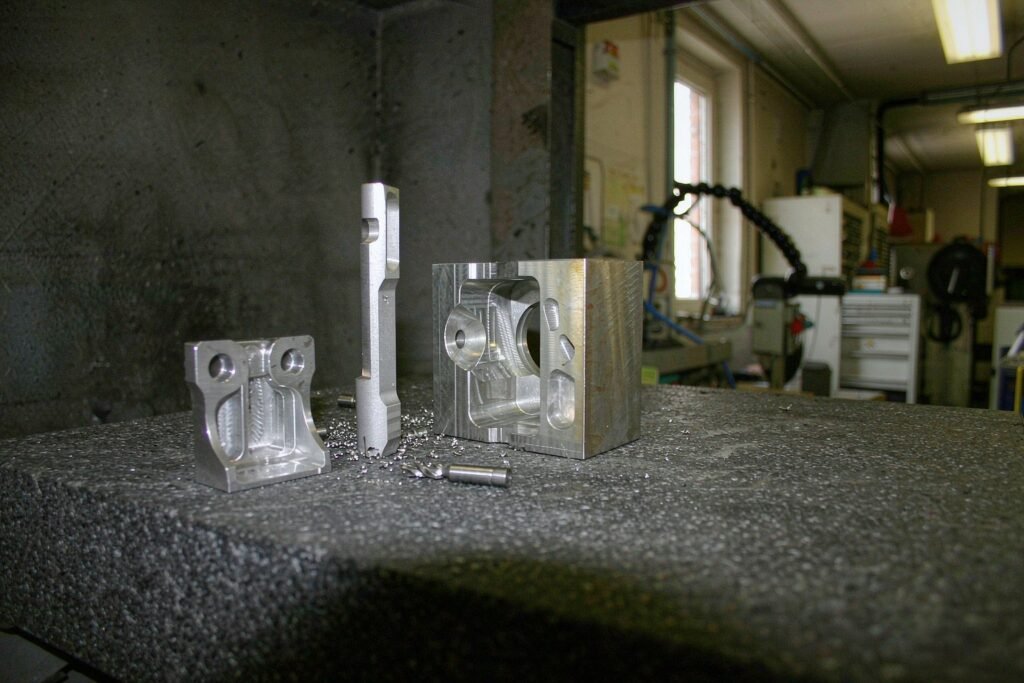
Titanium machined parts on a granite plate: a Ti-6Al-4V bracket with thin ribbed walls, a slender stepped medical implant trial part with a bead-blasted surface and a structural block with lightening pockets
05 · MATERIAL

Titanium

Bought for the ratio, not the number: about 60% of steel’s weight with comparable strength, and a stable oxide layer that survives seawater and body fluid. It is also the most expensive material on this page to cut.

grades
Ti-6Al-4V (Grade 5)Grade 2 commercially pure
key advantages
High strengthCorrosion resistanceLightweight
applications
Medical implantsAerospace componentsHigh-performance engineering parts
where this material bites
heatThermal conductivity is about a seventh of steel, so the heat stays in the edge. High-pressure coolant, low surface speed, sharp geometry and short tool engagement — and never dry.
swarfTitanium chips burn. They are never left to pile in the machine, and the coolant concentration is checked rather than topped up.
06 · MATERIAL

Engineering Plastics

POM, PEEK, PTFE and PA replace metal where the part has to insulate, resist a chemical, run without lubrication or stay light. Tolerances are achievable, but they only mean something if the measurement conditions are stated.
grades
POMPEEKPTFEPA (Nylon)
key advantages
LightweightInsulation propertiesChemical resistance
applications
Insulating partsWear componentsPrecision mechanical systems
where this material bites
moisturePEEK takes on 0.3–0.5% water and nylon considerably more, and a part that measures nominal dry will not measure nominal in service. State the condition on the drawing.
heat and clampPOM and PTFE both creep: the material keeps moving under a clamp load or a warm assembly. Clamping pressure and service temperature belong in the review, not in a footnote.
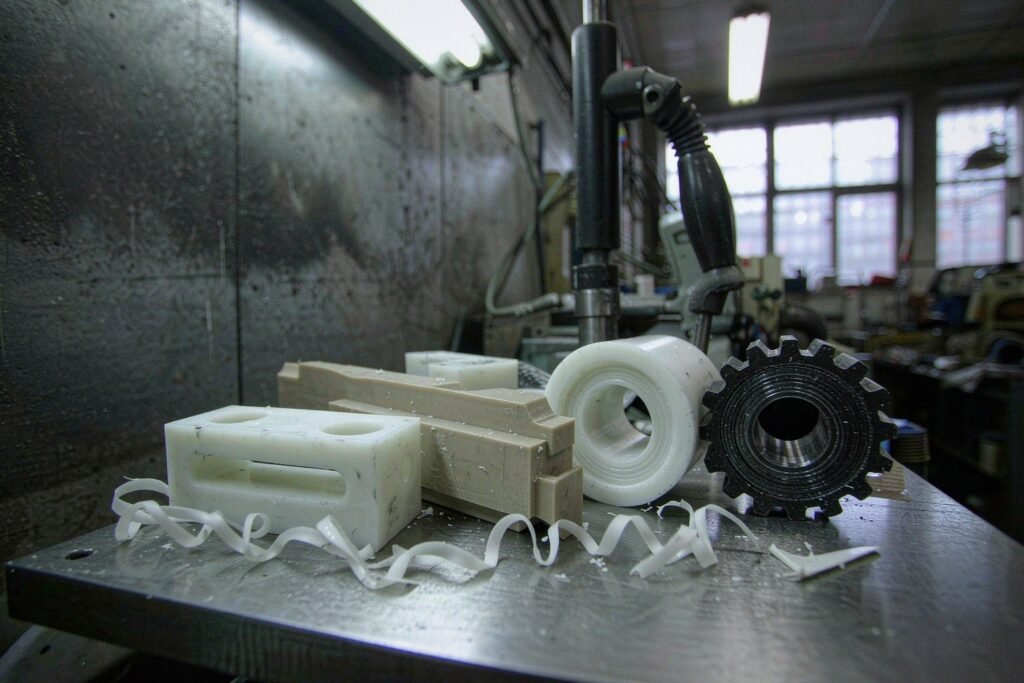
Engineering plastic machined parts on a steel table: a white POM sliding block with a milled slot, a beige PEEK spacer, a white PTFE bushing with turning rings and a black nylon gear blank with ribbony swarf
03 · machining behavior

How each material behaves at the cutting edge

Every material behaves differently during CNC machining. Aluminum allows high-speed machining with excellent precision; stainless steel needs work-hardening control; titanium makes heat management critical; plastics need deformation control. This is the part of the page worth reading twice, because it is the difference between a quotation and a guess. It is also why XS Precision quotes a cutting strategy rather than an hourly rate.

AluminumCuts fast and clean. Surface speed of 300–600 m/min, high spindle speeds, long tool life, excellent dimensional repeatability on a rigid setup.Thin walls deflect instead of cutting cleanly, and 7075 tears if the feed per tooth is too light for the depth of cut.Rough and finish separately, control chip evacuation so a recut chip does not mark a finished face, and hold 0.2–0.5 mm for the finishing pass on any wall under 3 mm.
Stainless SteelCorrosion resistance is bought with ductility: the material deforms ahead of the edge, then hardens where it deformed. 303 breaks chips, 304 and 316 smear.Rub a 304 surface and it gets harder, springer and hotter. Tools fail by notch wear and chatter, not by gradual flank wear.Keep the feed up and the speed down, use a positive rake and a rigid setup, and never let the cutter dwell. Coolant is aimed at the cut, not poured over the machine.
TitaniumAbout 60% of steel’s density with comparable strength, and poor thermal conductivity, so the heat generated at the edge has nowhere to go.Edge temperature above 1000 °C, crater wear on the rake face, chipping at the entry point, and a real fire risk from swarf if anyone tries to dry-cut it.High-pressure coolant, low surface speed, sharp edge, short radial engagement, and a fresh edge before the wear land starts to rub rather than cut.
PlasticsMachines with very low cutting forces at very high spindle speeds, and produces a continuous ribbon chip instead of a broken one.Heat build-up melts the surface, clamping stress creeps out, and moisture changes the size after the part has been accepted at goods-in.Sharp uncoated tooling, low depth of cut, air or flood cooling, generous clamping distribution, and an agreed soak condition before final measurement.
the five requirements pull against each other
StrengthAerospace, robotics, load-bearing structuresHigh-strength grades are harder, gummier or both, which shortens tool life and adds a heat-treatment step.Usually sacrificed first on parts that never see a real load, which is where aluminum or a plastic does the job for a fraction of the cost.
Corrosion resistanceMedical, marine, semiconductor, food equipment316L and titanium both cut slower than the steel or aluminum they replace, and the free-machining grades are the ones with less corrosion resistance.Rarely compromised: on a wet or sterile application the grade is the specification, and a cheaper material simply fails.
MachinabilityAny part where volume or lead time dominatesChoosing the easiest material to cut can mean accepting a lower strength or worse corrosion performance.The most common honest trade: 303 instead of 316, or a free-cutting brass instead of a lead-free one, wherever the application allows it.
Heat resistanceEngines, ovens, autoclaves, hot toolingHigh-temperature grades are expensive, often need a coating, and warp during heat treatment unless the sequence is planned.Usually bought outright: a part that sees 300 °C cannot be made from a material that softens at 120 °C.
Cost efficiencyAutomation, industrial equipment, repeat productionChasing cost alone is how a part arrives with an anodised wall that no longer meets the tolerance, or a leaded grade that fails an incoming material audit.The right place to compromise — but only against a requirement that has been named, not one that nobody checked.
04 · surface finish

Surface finishes and what they do to your tolerance

Surface finish is specified for a reason — wear, corrosion, appearance, or a sealing face — and almost every finish changes the part after the last machining cut. Anodizing and plating grow the workpiece; electropolishing removes material; black oxide barely moves anything but introduces hydrogen that has to be driven out. The finishing operation belongs in the tolerance chain, and the drawing should carry the pre-finish size, and that line is written on every XS Precision process plan before the part is scheduled.
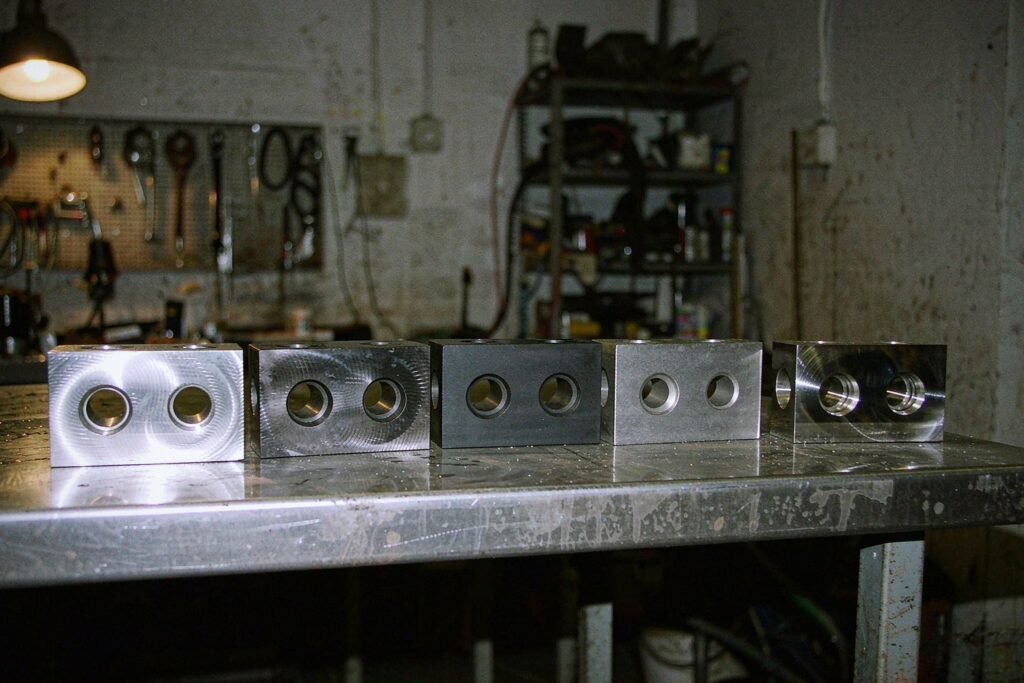
ONE SHAPE, FIVE FINISHES
One machined block shape in five surface finishes in a row: bare aluminium with tool marks, hard anodised grey, matte black anodised, bead-blasted satin and a mirror electropolished stainless face
The same block through five treatments: bare aluminum straight off the mill, hard anodised, matte black anodised, bead-blasted satin and a mirror electropolished stainless face. Same drawing, same tolerance, five different settling dimensions.
ProcessAluStainlessSteelBrassTiPlasticsEffect on size
Anodizing, sulfuric●○○●●○Adds 5–25 µm per surface; dielectric, so mask any earth path
Hard anodizing●○○○●○Adds 25–50 µm per surface, grows inward and outward; 7075 goes grey-brown
Electropolishing●●●○●○Removes 5–20 µm; deburrs and passivates at the same time
Passivation, ASTM A967○●○○●○No dimensional change; removes free iron from the surface
Nickel plating, electroless●●●●●○Adds 5–25 µm per surface, uniform on internal bores
Black oxide○●●●○○Adds about 1–2 µm; must be de-embrittled after pickling
Bead blasting●●●●●●Removes nothing measurable but raises Ra, typically 1.6 to 3.2 µm
Polishing / buffing●●●●●●Hand operation; removes material at edges more than on faces
PVD / DLC coating●●●○●○Adds 1–5 µm; needs a mirror substrate to look right
● standard  ·  ● conditional, verify grade and thickness first  ·  ○ not applicable
what we agree before the finish is applied
Pre-finish sizeThe tolerance on a finished drawing is the pre-finish size. We state the growth or removal on the process plan so the machinist does not have to guess which side of nominal to land.
MaskingAnodizing and plating are electrical processes: threads used as earth paths, press-fit bores and sealing faces have to be masked, or they arrive coated and out of fit.
Ra after blastingBlasting cleans and dulls, but it raises roughness. A sealing face that needs Ra 0.8 µm cannot be blasted; it needs to be machined or lapped and then protected.
Hydrogen embrittlementAcid pickling before plating or black oxide puts hydrogen into high-strength steel. Parts above roughly 1,000 MPa are baked after the process, and the record ships with the batch.
Certificate and lotElectroless nickel, anodizing and passivation all ship with a process certificate and a bath or lot reference. On a regulated part that reference is part of the deliverable.
05 · typical problems

Where each material ends up, and what tends to bite

Materials are widely used across automation systems, semiconductor equipment, medical devices, optical systems, robotics and industrial machinery — and the same grade causes different trouble in each of them. The four problems below are the material-related machining issues we see most often, and every one of them is cheaper to catch in the review than at first article — which is why the review at XS Precision happens before the quotation, not after it.

Aluminum deformation in thin-wall parts
Wall under 2 mm, finishing cut taken straight after roughing
If nobody models it: The wall springs back as the cutter passes, the part is accepted at goods-in and fails a flatness check at assembly, and the whole batch is suspect.
In the review: Separate rough and finish, remove material symmetrically, and leave the thin wall for a light finishing pass on a stabilised part rather than a stressed one.
Stainless steel machining hardness variation
304 or 316 cut with a light feed per tooth, or the tool dwelling in one place
If nobody models it: The surface work-hardens between passes, tools fail early, and a low-Ra requirement starts to look impossible. Operators then slow the spindle down, which makes it worse.
In the review: Feed properly, keep a constant engagement, and specify the free-machining grade where the corrosion requirement allows it. Where it does not, we plan for the tool consumption.
Titanium tool wear issues
Long continuous cuts with flood cooling instead of high-pressure through-tool coolant
If nobody models it: Crater wear on the rake face, chipping at the entry, and a tool change in the middle of a finishing pass that leaves a visible step on the part.
In the review: High-pressure coolant aimed at the edge, a lower surface speed, an edge geometry that shears rather than rubs, and a tool life budget agreed before the first cut.
Plastic dimensional stability under heat
POM or PTFE measured straight off the machine in an unheated shop
If nobody models it: The part measures nominal at goods-in and out of tolerance once it reaches a warm assembly or takes on moisture, and the argument is about the measurement, not the machining.
In the review: Soak the material and the part to an agreed condition before final measurement, state the reference temperature and humidity on the drawing, and machine to the mid-point rather than to the limit.
where these materials are used, and what each industry audits
TITANIUM, WHERE THE COST IS JUSTIFIED
Titanium machined parts on a granite plate: a Ti-6Al-4V bracket with thin ribbed walls, a slender stepped medical implant trial part with a bead-blasted surface and a structural block with lightening pockets
A Ti-6Al-4V bracket with ribbed walls, a stepped implant trial part and a structural block with lightening pockets. Titanium earns its price on parts where weight, corrosion and body compatibility all matter at once — not on parts that could have been aluminum.
finish reading the material question
06 · questions

Questions we get asked before a materials decision

Short answers from the Material Expertise desk to the questions that come up most often when a drawing first arrives. If the question you have is not here, it is usually answered on the material page or in the selection guide — and if it is not, ask it in the quotation and we will answer it in writing.

It depends on the application, the strength requirement and the cost target, and those three usually disagree. The honest answer is that no material is best in general: aluminum is best for low weight and fast production, stainless for corrosion and cleanability, carbon steel for stiffness per unit cost, brass for conductivity and easy cutting, titanium for strength-to-weight and body compatibility, and engineering plastics for insulation and chemical resistance. Send the drawing and the service conditions and we will tell you which family wins on your part.

Yes. Material selection is part of the quotation, not an extra service: before we price a part we check the grade against the loads, the environment, the finishing operation and the inspection method, and we tell you if the grade on the drawing is going to cost you more than it needs to. If a substitution would work, you get the reason and the saving in the same message.

Yes, both. PEEK and the other engineering plastics are machined on the same machines with dedicated tooling and controlled clamping; titanium is machined with high-pressure coolant and a tool life budget agreed before the run. Both materials cost more in time than in stock, so the quotation shows which one is driving the price.

Specify the grade if the part is regulated, qualified or already in service, because the change has to go through your own approval. Leave it open if the only requirement is functional — a drawing that says “stainless” instead of “316L” often means the customer has not decided, and that is a good moment to ask the question.

Because it changes the cutting speed, the tool life and the number of operations. Titanium at 20–40 m/min against aluminum at 300–600 m/min is machine time before anything else, and materials that work-harden also add tool changes and sometimes an extra finishing pass.

Yes. Material is booked in with its heat lot and certified to EN 10204 3.1, and the lot follows the batch through the shop. Heat treatment, anodizing, plating and passivation each add their own process certificate, so the documentation package matches the parts months later.

We say so before quoting rather than after delivering. The common cases are a free-cutting brass specified for a wet environment, 304 specified where 316L is needed, or an aluminum wall that is too thin for the tolerance called out. Each of those is cheaper to fix on the drawing than on the shop floor.

rfq

Need help choosing the right material?

Upload your drawing and the XS Precision engineering team will recommend the best material based on performance, cost and manufacturability. If the grade on the drawing is already right, we will say so and quote it; if a different one would serve you better, you will get the reason with the price.

STEP / STP / IGES / PDF / DWG / DXF
Reply within one working day
Request a quote today!