
CNC Machining for Medical Devices and Diagnostic Equipment
CNC machined parts for medical instruments and diagnostic equipment requiring high precision and reliability. Shenzhen XS Precision takes each programme from first prototype through repeat production, in titanium, stainless steel and medical-grade polymers, with the dimension reports and traceability records your quality system needs.
What Makes Medical Machining Different
XS Precision is a CNC machining supplier based in Shenzhen, China, working with OEM manufacturers, engineering companies and product development teams. Medical work is not judged the same way as general industrial machining — four things change how a part has to be produced.
Patient safety leaves no room for assumption
A part that drifts out of tolerance is not a cosmetic problem, it is a safety question. We confirm the drawing can be held on the quoted process instead of assuming.
Every component has to be traceable
Material certificates, inspection results and batch records are kept with the job, so a finished part can be traced back to the stock it was cut from.
Materials are specified, not interchangeable
Biocompatibility, corrosion behaviour and sterilisation decide the material. We never swap in a cheaper alloy to bring the price down.
Designs keep moving during development
Clinical feedback changes geometry more than once. Prototype runs have to be fast enough to keep pace with those revisions.
Where Medical Programmes Usually Get Stuck
Four problems we hear most often from device teams, and how we handle them.
Paperwork that does not hold up
Records are written to be audited, not just delivered. Material certificates and dimensional reports are built as the job runs rather than reconstructed afterwards.
Features too small for standard tooling
Micro-features, thin walls and fine channels are cut on machines chosen for the geometry, with tooling and fixturing planned before the first cut.
One volume that suits no single supplier
Validation parts, pilot batches and repeat volumes run through the same process, so a design proven on ten pieces is not re-qualified at two thousand.
Too many suppliers for one assembly
Several machined parts, a finishing step and clean pack-out can be coordinated under one order, so the quality record covers the whole build.
Tolerances and Capacity
What XS Precision holds on medical work, and how much of it we can run in one order.
±0.01 mm
Typical production tolerance held across a batch. Confirmed against your drawing before the job is quoted.
±0.005 mm
Achievable on micro-features, small bores and critical mating surfaces where the drawing calls for it.
3 / 4 / 5-axis
Milling and turning, including simultaneous 5-axis work for geometry that cannot be reached in three setups.
1 – 5,000+ pcs
From a single validation part to repeat production, without changing supplier or process route.
Medical Components We Machine
CNC machined parts for medical instruments and diagnostic equipment requiring high precision and reliability. Typical parts XS Precision produces:
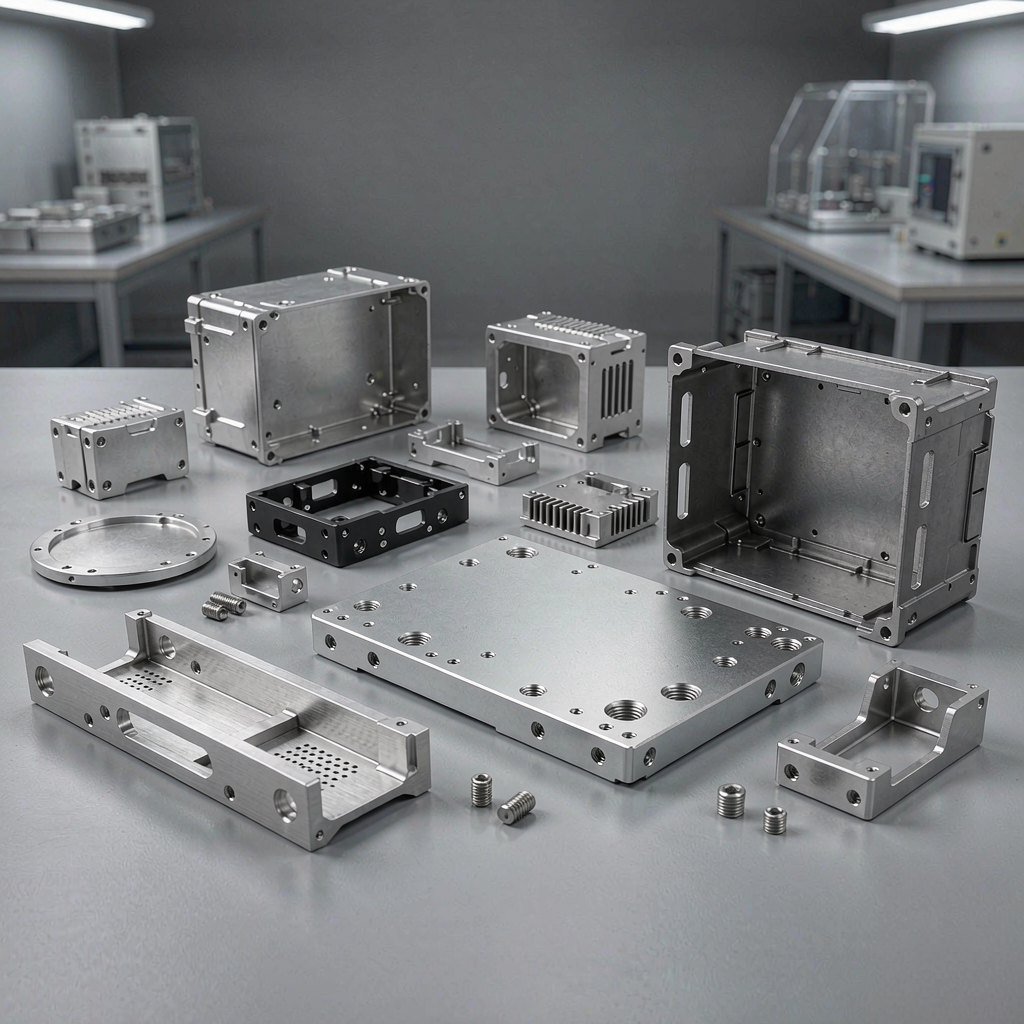
Device housings
Machined enclosures, frames and mounting plates for diagnostic and imaging systems, held flat and true where sealing and alignment depend on it.

Surgical components
Handles, shafts, jaws and mechanism parts in stainless steel, machined to work as an assembly and to survive repeated sterilisation cycles.

Orthopedic and spinal implant parts
Titanium and cobalt-chrome components where surface condition and dimensional accuracy both carry clinical weight.

Sensor mounts
Brackets, holders and alignment features that set where a sensor sits, so the tolerance on the mount becomes the tolerance on the measurement.
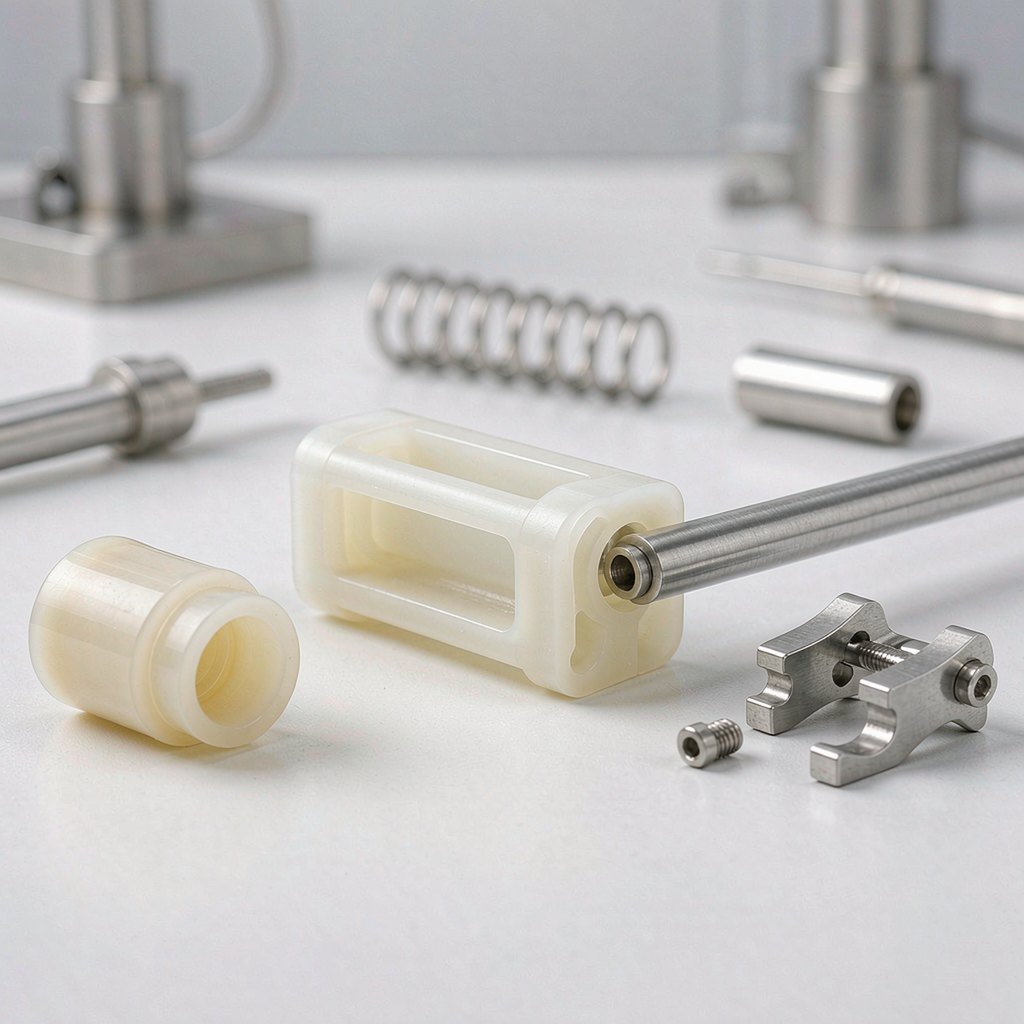
Medical robotics and drug delivery
Precision linkages, manifolds and polymer components for automated dispensing and robotic platforms.

Endoscopic and minimally invasive parts
Small-diameter shafts, sleeves and micro-features for instruments that work inside the body and must not fail in service.
Medical-Grade Materials
Materials XS Precision machines regularly for medical applications, and why they get specified. Full grades and properties are listed on the material expertise pages.
Titanium (Ti-6Al-4V)
Biocompatible, strong and corrosion resistant. Used for implants, fixation hardware and instrument parts that stay in contact with tissue.
Stainless Steel (316L / 17-4 PH)
The default for surgical instruments and reusable equipment. Resists corrosion and survives repeated sterilisation cycles.
PEEK
Radiolucent, chemically resistant and sterilisable. Chosen for spinal cages, guides and parts that must not appear on imaging.
Cobalt-Chrome Alloys
High wear resistance for articulating surfaces and load-bearing implant components that see continuous movement.
Aluminium (6061 / 7075)
Light, rigid and dimensionally stable for equipment frames, housings and non-implanted components.
PPSU and PEI (Radel, Ultem)
High-performance polymers that survive autoclave and gamma sterilisation. Used for handles, trays and reusable housings.
Quality Control and Traceability
Inspection is planned into the job rather than added at the end of it.
01 Material verification
Incoming stock is checked against its certificate before it reaches a machine, and the heat or batch number is recorded against the job.
02 First article inspection
The first part is measured across the dimensions and geometric tolerances on the drawing before the run is allowed to continue.
03 In-process control
Critical dimensions are checked at set intervals through the batch, so a drift is caught while there is still time to correct it.
04 Final inspection and records
Parts are measured before packing, and the inspection report, material certificate and traceability record ship with the order.
Documentation XS Precision issues with every medical order: material certificate · dimensional inspection report · first article report · certificate of conformance · batch traceability record. If your quality system uses a specific template, send it over and we will complete it in your format.
Machining Processes and Finishing
The processes we run, and the finishing steps managed as part of the order.
Machining
- 3, 4 and 5-axis CNC milling
- CNC turning and mill-turn work
- Micro-machining of small features
- Precision surface grinding
- Wire and sinker EDM
- Deburring and edge preparation
Finishing and post-processing
- Passivation and electropolishing
- Anodising and hard anodising
- Bead blasting and media finishing
- Mirror and fine surface polishing
- Laser marking and part identification
- Clean packing and protective packaging
From Prototype to Repeat Production
XS Precision runs prototype, pilot and repeat volumes on one process route, so the low-volume production step does not start from a new qualification.
Prototype and validation builds
One to twenty pieces, machined to production intent so the design is validated on the process it will actually run on. Typically 5 to 10 working days after drawing approval.
Pilot and bridge production
Small batches that carry a device through verification and into the market while tooling decisions are still open.
Repeat production
Scheduled batches with the inspection plan, material source and process route already fixed from the earlier runs.
Your Design Stays Yours
A medical design carries years of development and regulatory work behind it. Sending out drawings should not create a new risk.
We sign a non-disclosure agreement before drawings change hands, keep project files with the engineers working on your job, and never use a customer part as a reference without written permission. If your programme requires drawings to be returned or destroyed at the end of a project, that is written into the agreement rather than left to trust.
- NDA signed before drawings are shared
- Files limited to the engineers on your job
- No third-party use of customer designs
- Written permission required for any reference
- Drawings returned or destroyed on request
Questions Medical Teams Ask Us
The answers below cover compliance, materials, tolerances and how a medical order is handled from quote to delivery.
Who is XS Precision?
Shenzhen XS Precision is a CNC machining supplier based in Shenzhen, China. The company works with OEM manufacturers, engineering companies and product development teams on prototype development, low-volume production and custom precision parts, with engineering review carried out before a job is quoted. Capabilities cover 3-, 4- and 5-axis milling, turning, micro-machining, EDM and grinding, with finishing and documentation handled under the same order. Background on the team and the facility is on the about XS Precision page.
Where is XS Precision located?
XS Precision is based in Shenzhen, in Guangdong province, China. Finished parts are packed for export and shipped to overseas customers, with the inspection report, material certificate and traceability record included in the shipment.
What documentation comes with a medical order?
A material certificate for the stock used, a dimensional inspection report and a certificate of conformance. Batch numbers are recorded so a finished part can be traced back to its material. If your quality system works to a specific report format, send us the template and we will complete it in that format.
Which materials does XS Precision machine for medical parts?
XS Precision machines titanium (Ti-6Al-4V), 316L and 17-4 PH stainless steel, cobalt-chrome alloys, PEEK, PPSU, PEI, and 6061 or 7075 aluminium for medical work. Grades and typical applications are listed on the titanium and stainless steel pages. Tell us what the part has to do and which standard it has to meet, and we will confirm whether the material is one we run regularly.
What tolerances can XS Precision hold on medical components?
General tolerances follow ISO 2768 unless your drawing states otherwise. On production work XS Precision typically holds ±0.01 mm, and down to ±0.005 mm on critical features where the drawing requires it — see the high precision components page for how those are measured. Anything tighter is reviewed before quoting rather than assumed.
Can XS Precision handle both prototypes and production volumes?
Yes. Validation parts, pilot batches and repeat production run on the same machines and the same inspection standard, so a design does not have to be re-qualified when the volume changes. The prototype manufacturing stage is machined to production intent for exactly this reason.
How long does a medical part take?
Prototype work normally runs 5 to 10 working days after drawing approval. Production batches depend on quantity, material availability and finishing, and the lead time is confirmed together with the quotation.
Will you sign an NDA?
Yes, and we sign it before drawings are shared. Files stay with the engineers working on your job, and customer designs are never used as references without written permission.
Can you work from a design that is not final?
That is normal in development. Send what exists and describe what the part has to do. We will point out features that are expensive to machine, tolerances tighter than the application needs, and material choices that would be easier to source and document.
Do you manage finishing and packing as well?
Passivation, electropolishing, anodising, blasting, polishing and laser marking are coordinated as part of the order, along with clean packing so parts arrive ready for your incoming inspection.
Send Us a Drawing
Send Shenzhen XS Precision a STEP file and a drawing with tolerances marked, and our engineers will come back with a manufacturability review, price and lead time — normally within one business day.