
CNC machined Stainless Steel parts for Medical devices, Industrial equipment and Marine components
Stainless Steel earns its name from a film you cannot see: a chromium oxide layer one to three nanometres thick. Everything we do to a stainless part — the grade we cut, the insert we run, the acid we dip it in — either protects that film or destroys it. XS Precision machines all four grades below and knows exactly which ones do not survive salt water.
The three reasons these grades end up on drawings are Corrosion resistance, High strength and Good durability. The catch, which almost nobody puts on the drawing, is that no single grade delivers all three at once — and the expensive grade is sometimes the wrong one.
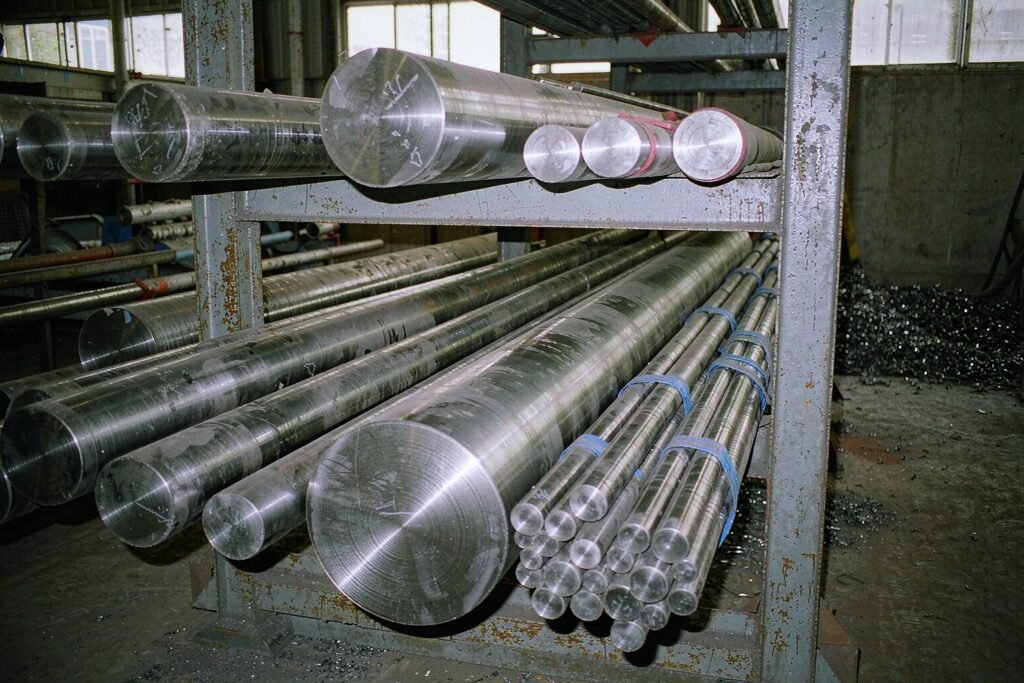
Stainless round bar waiting for a saw cut
Four grades, one passive film, and a set of thresholds nobody prints on the drawing
PREN = %Cr + 3.3 × %Mo + 16 × %N. It is the closest thing this material family has to a single score for how well it resists pitting, and it is the fastest way to see why one of these four grades does not belong in sea water. XS Precision quotes against that number before quoting against the bar price, because the two rarely point the same way.
303, 304, 316 and 17-4PH are not four versions of the same thing
Two of them are austenitic and cannot be heat treated harder. One is a free-machining variant sold for the swarf it makes. One is precipitation hardening and is the only member of the group that gets anywhere near tool steel strength.
Corrosion resistance: where each grade actually sits
17-4PH is the strongest stainless steel most buyers will ever spec, and it has the lowest PREN of anything on this page. It contains no molybdenum at all, and molybdenum is the element that buys resistance to chloride pitting. Where the drawing says 17-4PH and the part lives near salt, something has gone wrong upstream.
The same thresholds expressed as chloride concentration, which is how the problem usually arrives: a wash-down specification, a process stream, or a customer asking whether 304 will do.
Marine components: why "marine grade 316" is a statement with an expiry date
This is the conversation we have most often, and it is the most valuable one to have before cutting metal. Grade 316 is excellent in a hundred environments. Prolonged immersion in warm seawater is not one of them.
NORSOK M-001 does not qualify 316L for seawater service. The Norwegian offshore material standard starts at duplex 2205. North Sea field records put the difference in plain terms: 316L piping in cooling water above 20 °C typically shows first pitting inside six to eighteen months; in splash zones, chloride stress corrosion cracking shows up at three to eight years. Properly designed 2205 runs fifteen to twenty-five years in the same duty.
Two thresholds decide it. Critical pitting temperature is measured per ASTM G48 Method E. Critical crevice temperature is the one that actually fails parts, because crevices are everywhere — under bolt heads, behind gaskets, inside threaded joints, beneath barnacles. Both numbers below are for the same test conditions, so they compare directly.
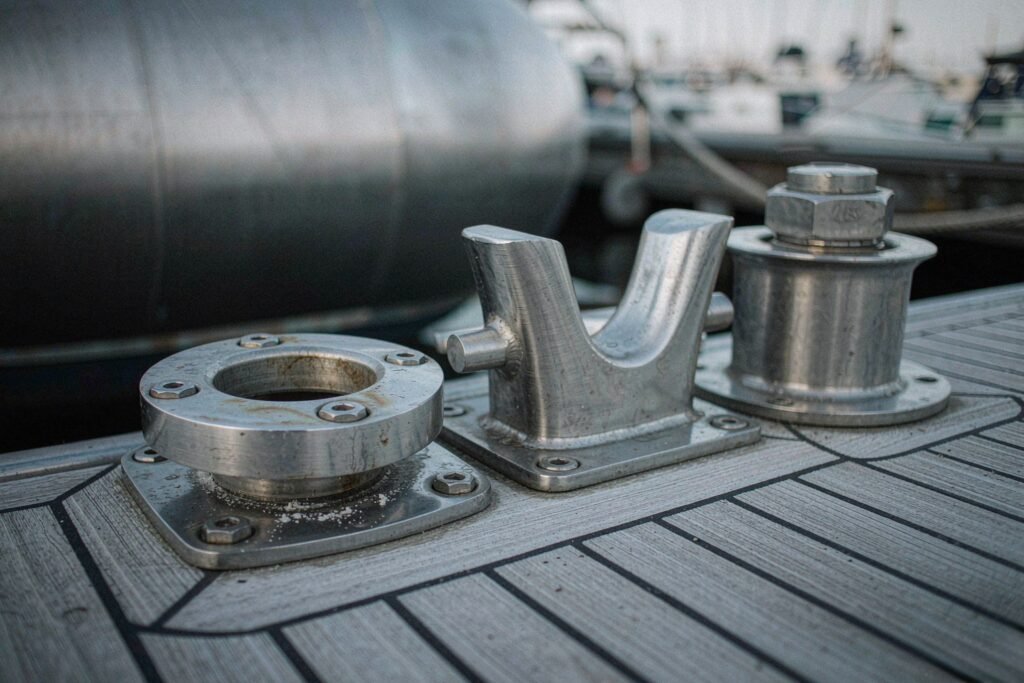
Tea-staining already starting in the crevice of this fitting
Good machinability is worth roughly one grade downgrade
Free-cutting steel B1112 sets the benchmark at 100%. Everything stainless sits well below it, and the spread between grades is wide enough to change which part is cheaper to make. 303 machines nearly twice as easily as 316 — the same drawing in 303 can cost meaningfully less even though the bar costs about the same.
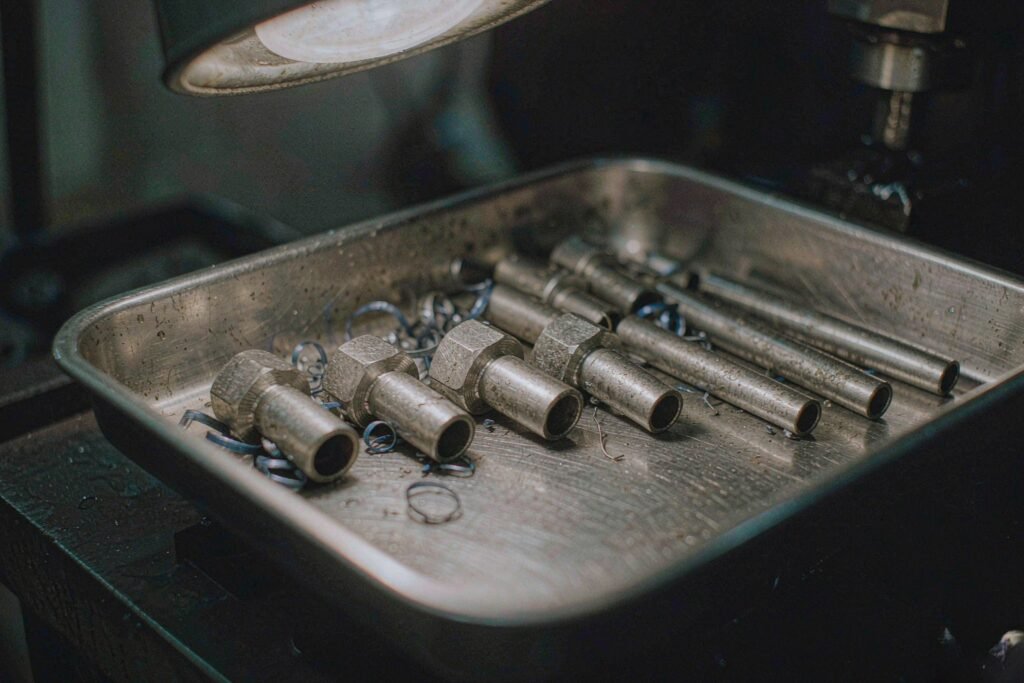
Turned stainless parts leaving the lathe with their swarf
Work hardening is not reversible. Once the surface has been cold-worked by a rubbing tool, running the same path again will not clean it up — you need a deeper cut with a sharp tool to get below the hardened skin. Keep chip load positive, never dwell mid-cut, climb mill only, and change inserts on a schedule rather than when they start complaining. Prevention costs nothing; the fix costs the part.
High strength in 17-4PH: the ageing condition works both ways
Solution treat at 1,020–1,050 °C, then age. Every step down the ladder buys toughness and resistance to stress corrosion cracking by giving up strength. The mistake is specifying “17-4PH” without a condition, which leaves the choice to whoever is holding the furnace — and the wrong choice is not recoverable without re-solution treating.
Weld decay: 316 versus 316L is a question about 0.05 percent carbon
Heat any austenitic stainless into the 425–815 °C band and carbon migrates to the grain boundaries, where it ties up chromium as carbide. The strip either side of the boundary is left short of chromium and loses its passive film. A weld passes through that band whether you intended it to or not.

Heat tint in the HAZ marks exactly where the steel lost time in the sensitising band
316L does not pit less than 316. Both carry the same 2–3% molybdenum, and both compute to a PREN of 24–26. Buying 316L for a part that never sees a weld adds three to eight percent to the material bill and buys nothing.
Specify 316L at the weld, not across the bill of materials. Thick-section welded construction in corrosive service is the case that justifies it; everything else is fine on 316.
Pickle and passivate after welding. Weld scale and heat tint are not cosmetic — the tinted zone is chromium-depleted material waiting for an electrolyte.
303 is not weldable. The sulfur that makes it machine so well makes weld metal crack. If the assembly gets welded, start at 304.
Passivation removes the iron that machining left behind
Stainless steel arrives passivated and leaves the machine shop with free iron smeared over it — from tool steel inserts, carbon steel fixtures, wire brushes that were used on something else last week. That iron rusts first, and it rusts in the places where the passive film should be doing the work.
The cycle, per ASTM A967. Alkaline degrease first — acids cannot passivate oily metal. Then immerse: nitric at 20–50% for 20–30 minutes at 49–71 °C, or citric at 4–10% for 30–60 minutes at 60–71 °C. Rinse in deionised water and let the film form in air for 24–48 hours.
It changes nothing you can measure. No thickness, no colour, no dimensional change — passivation conditions the existing surface rather than adding a coating. Electropolishing removes metal and does passivate as a side effect, but it is a different operation with different tolerances.
Verify with the copper sulfate test to ASTM A967 Practice B. Thirty seconds of orange spotting tells you more about your shop discipline than any certificate will. Aerospace work asks for AMS 2700 instead; aerospace-adjacent work often accepts either.
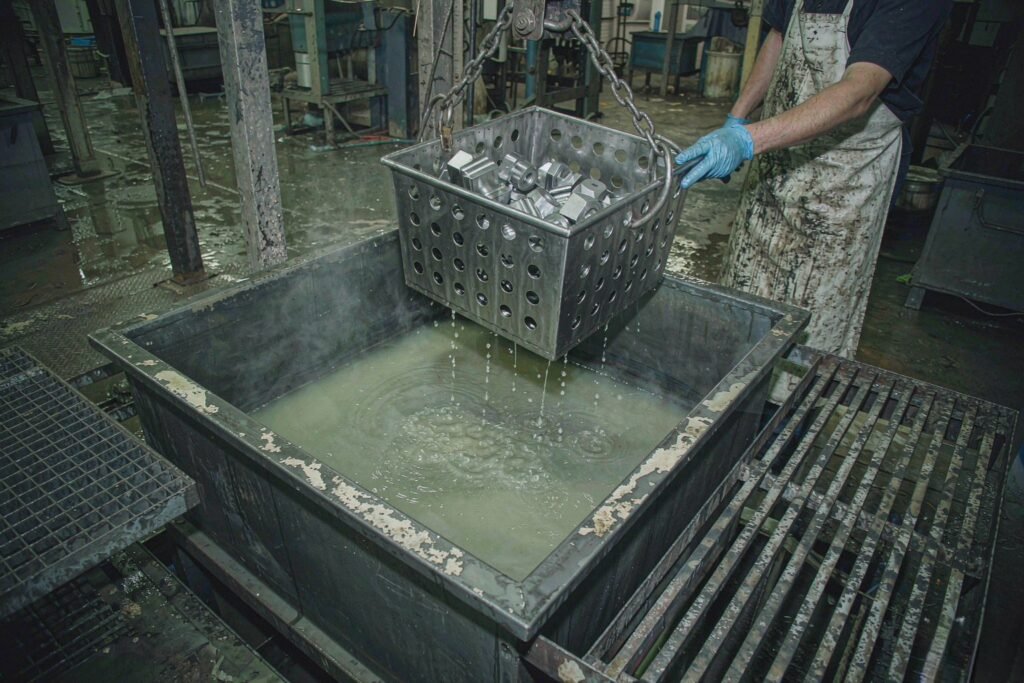
A basket of machined parts coming out of the passivation bath
Medical devices, Industrial equipment and Marine components each have a different constraint
The grade that satisfies the strongest constraint usually wins, and the constraints do not overlap much between these three.

Surgical instruments in brushed stainless
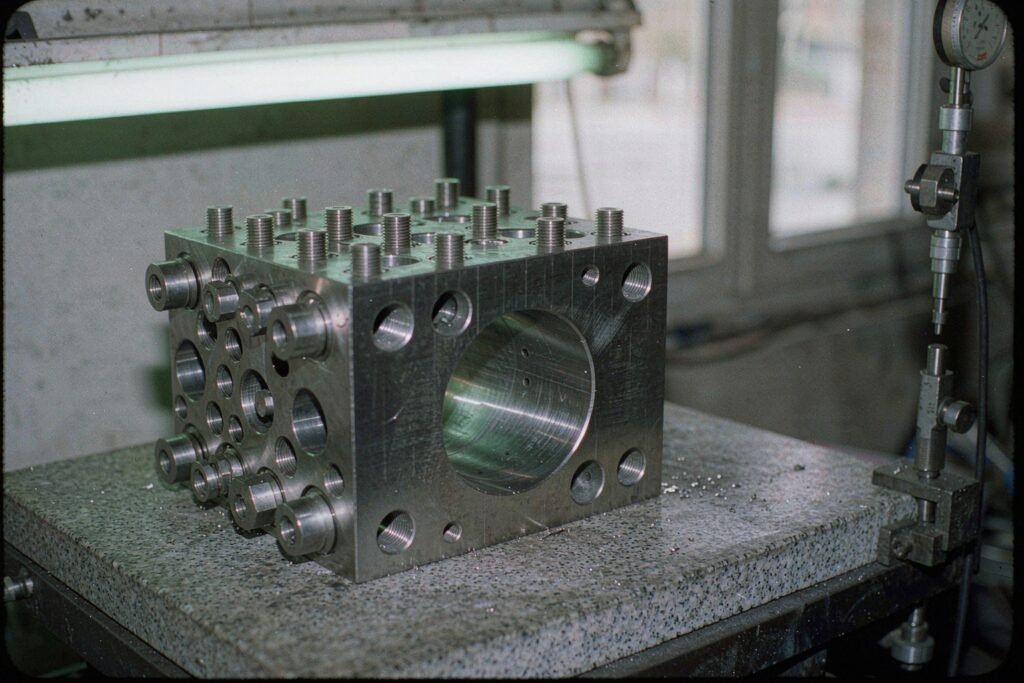
A hydraulic manifold with bored galleries
Marine deck hardware, with crevices everywhere
Medical devices. Repeated sterilisation is a corrosion test, not a cleaning step. 316L handles the saline and autoclave cycles that would pit 17-4PH; 17-4PH H1025 carries the cutting edges and the spring elements that need yield strength. Instruments are usually the combination, not one grade. ISO 13485 documentation and material traceability to ASTM F138 come with the territory, so tell us up front if a device history record is required.
Industrial equipment. Wash-down chemistry and cost per part dominate. 304 covers most frames, brackets and enclosures; 316 or 316L is specified where the cleaner or the process stream carries chlorides. Manifold blocks and valve bodies are where our fixtures earn their keep — deep intersecting galleries, tight port spacing and deburring done before the first pressure test.
Marine components. The honest answer: most hardware is 316, most failures happen in crevices, and the parts that fail are the ones bolted down rather than the ones washing clean. Design the crevice out before upgrading the alloy — then consider 2205 if the assembly sits warm and loaded.
Cost-effective is a property of the finished part, not of the bar
Q3 2026 benchmarks: 304 cold-rolled coil trades at roughly US$2,255–2,480 per tonne, and 316 at US$3,410–3,680. The gap between them has widened from about 45% in early 2025 to 51% now, and molybdenum is the reason. Indonesia cut its 2026 nickel ore quota from roughly 379 million to 260 million wet tonnes, which lifted the floor under every nickel-bearing grade, and EU CBAM added US$40–80 per tonne of carbon compliance cost for Asian mills. XS Precision buys against the mill certificate every time, because the two cheapest substitutions on this page — 304 sold as 316, and 304 offered without molybdenum — both look identical in a bar rack.
Certificates, PMI verification and the incoming inspection worth paying for
The most common stainless problem is not counterfeit material. It is near-equivalent substitution — 304 shipped where 316 was specified, or 201 quietly standing in for 304 in Asian-sourced stock. The certificate says one thing, the heat number stamped on the bar says another, and nobody checks until the part has been installed for a year.
PMI is the highest-value twenty dollars per heat. A handheld XRF gun resolves molybdenum content in about thirty seconds, which is the fastest independent way to confirm that 316 is actually 316 and that nobody has substituted something cheaper. At XS Precision we run it on incoming stainless bar as a matter of routine, alongside a hardness spot check — which is the cheapest available answer to “did anyone really perform that heat treatment?”
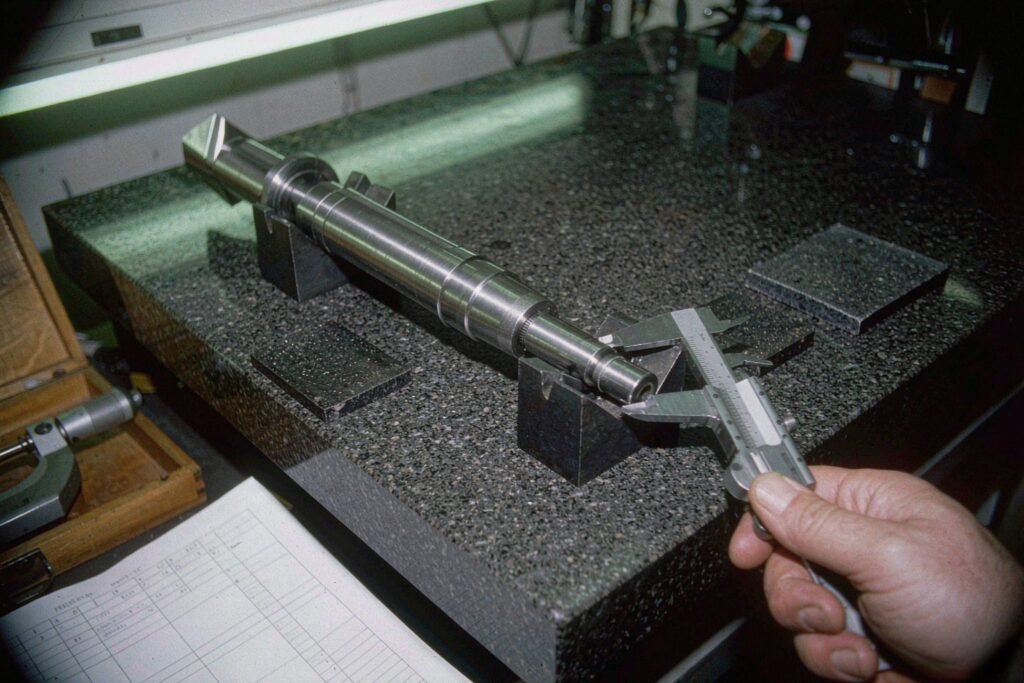
Dimensional check against V-blocks before anything ships
Three ways a stainless specification quietly goes wrong
None of these fail on the machine. They fail six months later, which is why they are worth ten minutes at the quotation stage.
The six questions we field most often about Stainless Steel
These come up on nearly every stainless enquiry, so here they are with the answers we would give on the phone. XS Precision has been machining these four grades for OEM customers in Europe and North America, and none of the answers below depend on which one you pick.
Is 316 the right default, or should I specify 316L?
Both compute to the same PREN of 24–26, so neither resists pitting better than the other. 316L restricts carbon to 0.030 percent maximum against 316’s 0.08, which stops chromium carbide precipitation in the weld heat-affected zone. If the part is welded in thick section and then meets a corrosive, specify 316L. If nothing is welded, 316L costs three to eight percent more for no benefit. Careful purchasers certify once to both.
Why is my 316 rusting by the sea?
Almost always crevice corrosion rather than general corrosion. 316’s critical crevice temperature is 0–5 °C, so attack is possible at ordinary ambient temperature wherever oxygen is excluded — under bolt heads, behind gaskets, inside threaded joints, beneath marine growth. Redesigning the crevice out usually buys more than upgrading the alloy, and where it does not, duplex 2205 roughly doubles the headroom.
Can you machine 17-4PH, and in what condition?
Yes, and it is easier than either austenitic grade while it is in the solution-annealed condition — around half of free-cutting steel against 316’s thirty-six percent. Expect 40–90 m/min in milling and 50–120 in turning. Machining fully aged stock is a different job with different tooling and a worse cycle time, so we usually rough it annealed, apply the ageing treatment, and then finish grind or hard-turn the critical features.
Will the part be magnetic?
303, 304 and 316 are austenitic and effectively non-magnetic when annealed, though cold working will pull a weak magnetic response out of them. 17-4PH is martensitic after ageing and is genuinely magnetic. If the assembly sits near a sensor, an MRI suite or a compass, say so early — it can eliminate 17-4PH outright.
Should every stainless part be passivated?
Anything that has been machined, welded or handled with carbon steel tools should be. The process removes free iron and lets the chromium oxide film reform per ASTM A967; it adds no thickness and changes no dimensions. Nitric acid at 20–50 percent for 20–30 minutes is traditional, citric at 4–10 percent for 30–60 minutes is safer to handle and easier to dispose of. We verify with the copper sulfate test rather than assuming.
What do you need from me to quote accurately?
A STEP file, the grade with its standard and condition — for example “316L per ASTM A276, annealed” or “17-4PH per AMS 5604, H1025” — the chloride exposure and temperature range, any certificate level above EN 10204 2.1, and whether a finish or passivation is specified. The environment and the condition are the two answers that most often change the quote.
Related capability and material pages to read next
Precision CNC machining
Turning, 3-, 4- and 5-axis milling, and the work holding that keeps thin-walled stainless features round.
High-precision components
Where tight tolerance and documented inspection meet stainless: medical, optical and metrology hardware.
Low-volume production
Prototype through small batch, with the process routed once and held steady across repeats.
Carbon Steel
When Stainless Steel is over-specified: C45 and alloy steel for structures that never meet an electrolyte.
Titanium
Implant-grade biocompatibility and half the weight, at a multiple of the material cost.
Aluminium
The other direction: a third of the weight and roughly ninety percent machinability.
Brass & Copper
For conductivity and bearing behaviour rather than strength.
Engineering Plastics
Where chemical resistance matters more than load, and weight is the binding constraint.
All materials
The full material index, including semiconductor, medical, optical and industrial applications.
Send the drawing. We will tell you which grade survives the environment.
Tell us the chloride exposure and the temperature range and we will tell you honestly whether 304 is enough, whether you need 316L, or whether the part belongs in duplex. If it needs 17-4PH we will also ask what it sits next to, because that grade is magnetic.